Looking Back on my journey and seeking the stories of my ancestors
Be yourself; Everyone else is already taken.
— Oscar Wilde.
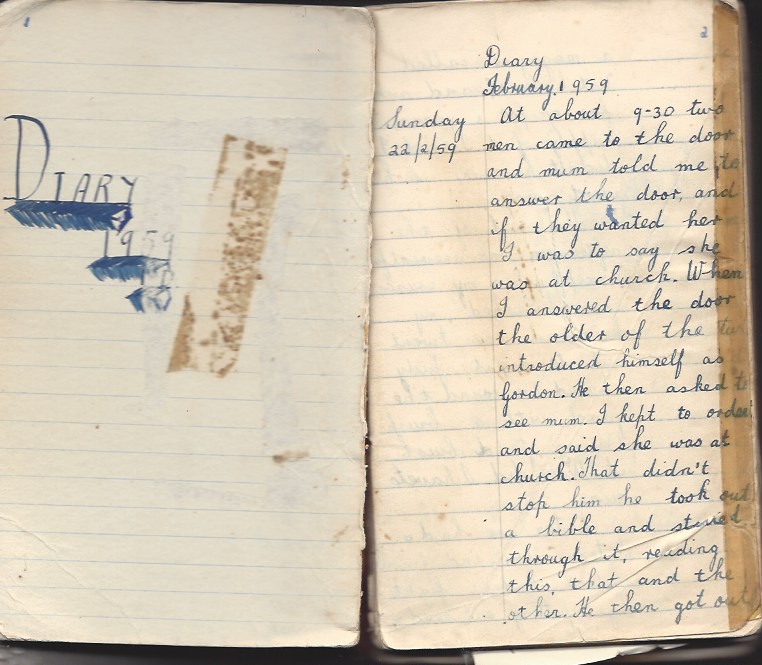
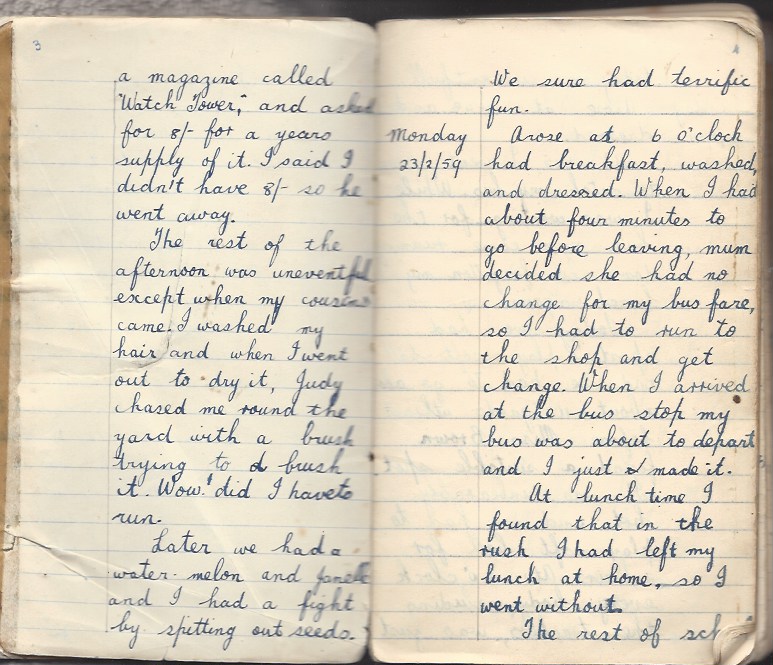
It was on Sunday 22 February, 1959 that I wrote in my first diary. My English teacher, Miss Pamela Browne had set us the homework task the previous week to write a diary.
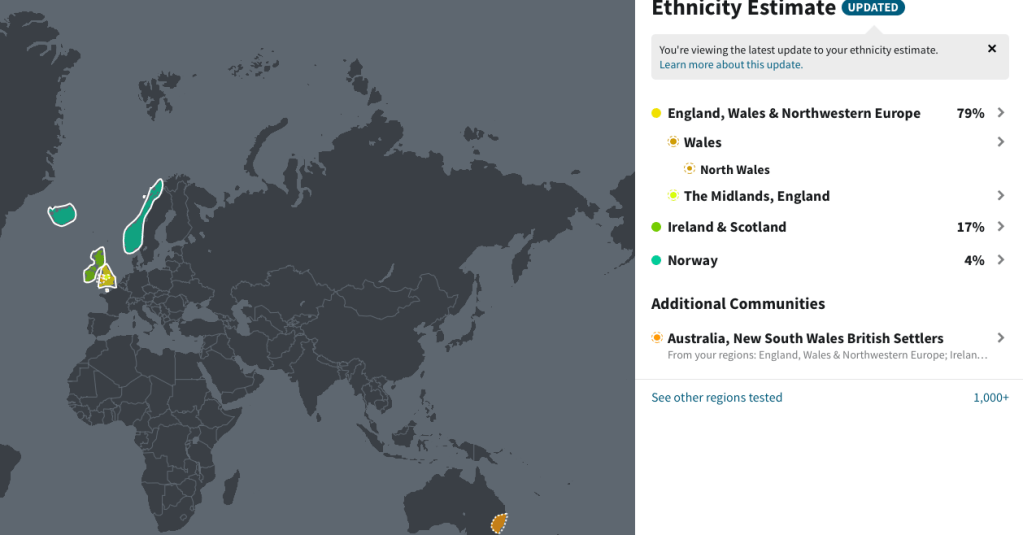
This is about MY roots. Looking back into where I came from, who made me, and where they came from, who were they, where did they live, what were their lives like and so on. The map below shows where my DNA threads come from.
Although I knew some of the story of my mother, Edna Leake’s family story, I never knew my father, Herbert Charles Aldridge. The early family myths were that he had died in ‘the’ war (WWII) prior to my birth. This I accepted as truth until it was too late to confront those who might have known the truth. There were no photos, nothing to tell me about the man who helped create me. My search for answers began in earnest in the late 1980’s following the death of my Aunt Della. My mother had passed away in 1979 and Della was the last person who could have filled in some of the gaps, but had chosen not to. I was living in Canberra and had access to the wonderful National Library of Australia. Starting with my Birth Certificate, I was able to obtain copies of both my parents’ Birth Certificates, and the journey back in time began…
David Leake was born in the Coal Mining region of Brownhills, Staffordshire, England, on Christmas Day, 1856; the second son of coal miner, John Leake (32) and Mary (31) (nee Wright).
In the 1871 Census of England, David and his siblings were living with their mother in Wolverhampton Road, Ogley Hay, Staffordhire. By then, his father and older brother had emigrated to the USA. By the end of 1871, Mary and the rest of the family joined John at Pompey Smash, Vale Summit in Maryland.
Tragically his father was killed in a coal mine in 1874. Within a year of his father’s death, nineteen year old David left the family and returned to England, possibly back to his home county of Staffordhire. It is more than likely that he had already formed a romantic connection with Mary Ann Bampton, who lived with her family in Foxes Row, Ogley Hay. (1971 England Census).
At the age of 21, under the Assisted Migrant Scheme he sailed to Sydney Australia, arriving on “La Hogue” on 15 November 1877. David was a coal miner, and I think he initially took up employment in that industry at Greta near Cesnock.
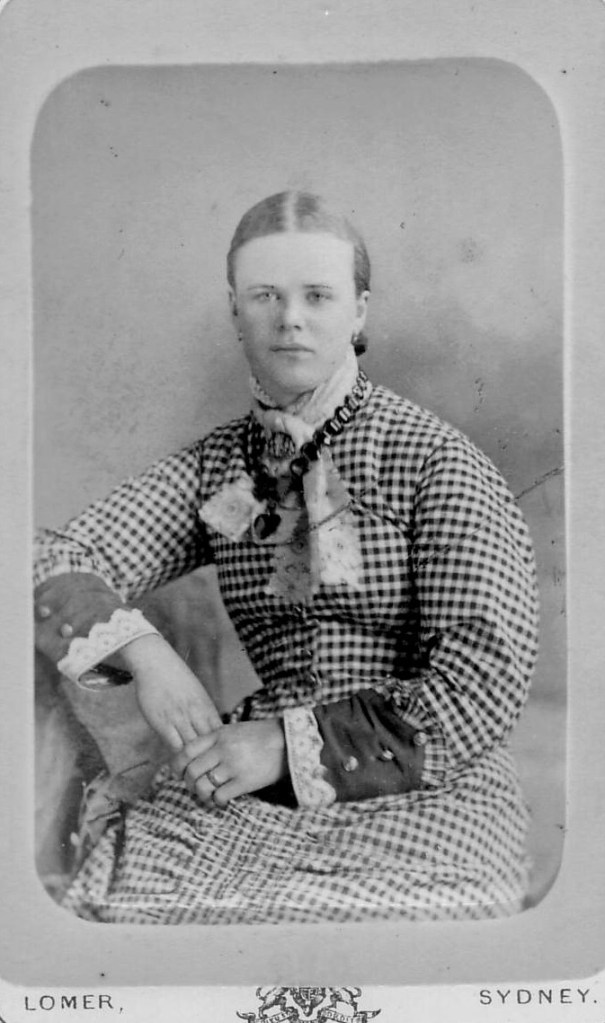
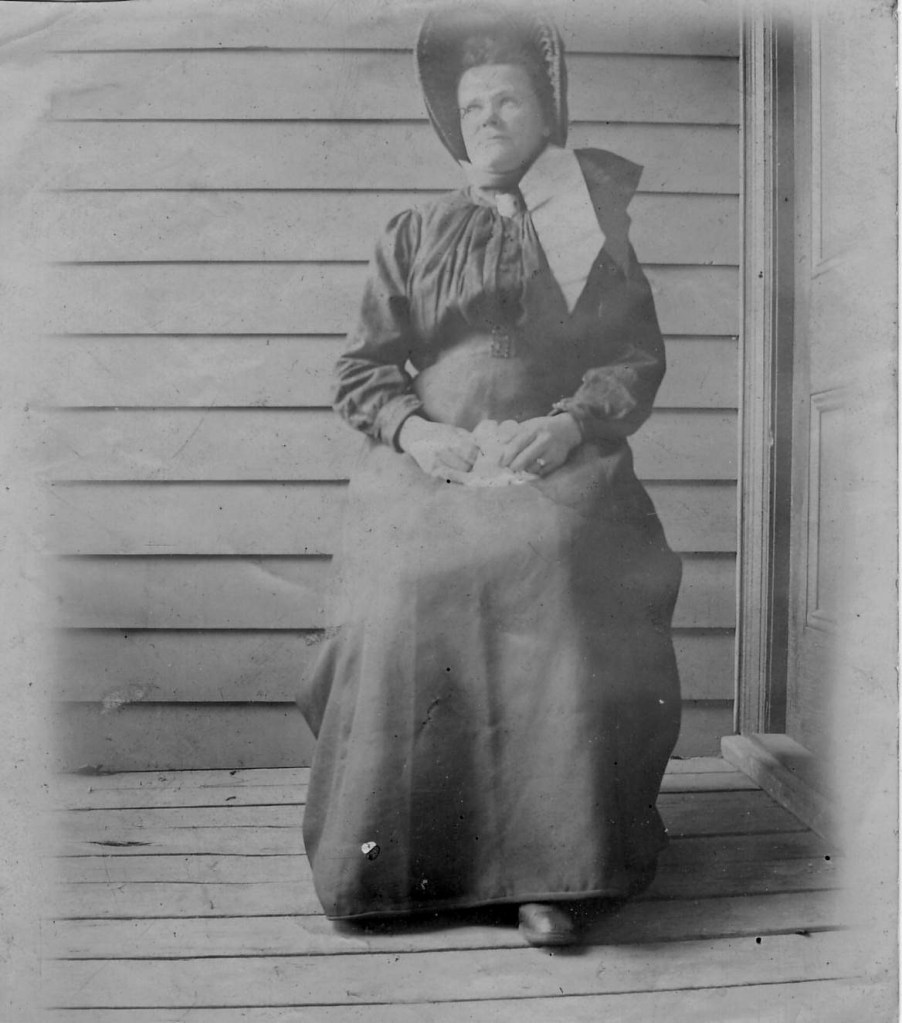
Three years later, Mary Ann joined David in Australia and they married on 15 January 1880 at the Wesleyan Parsonage, Prince Street in Sydney. Their marriage certificate noted that the 21year old Mary Ann had “just arrived from England”. This photo of my Great Grandmother, must have been taken upon her marriage to David, because I notice that she is wearing a shiny new wedding ring.
The following year Mary Ann gave birth to their first son, Edwin, in ‘Hartley Vale’ near Lithgow. My grandfather, Arthur arrived in 1883 followed by two more children, a son John who died at the age of 1 and finally in 1893, their only daughter, Emma, who was named after Mary Ann’s mother.
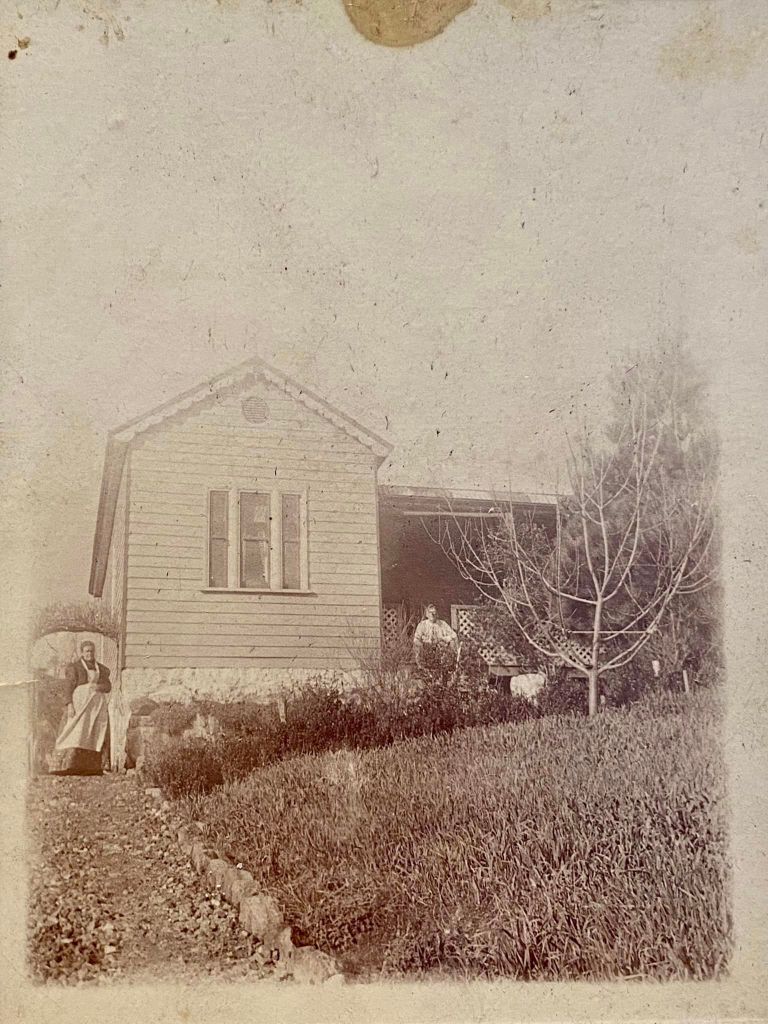
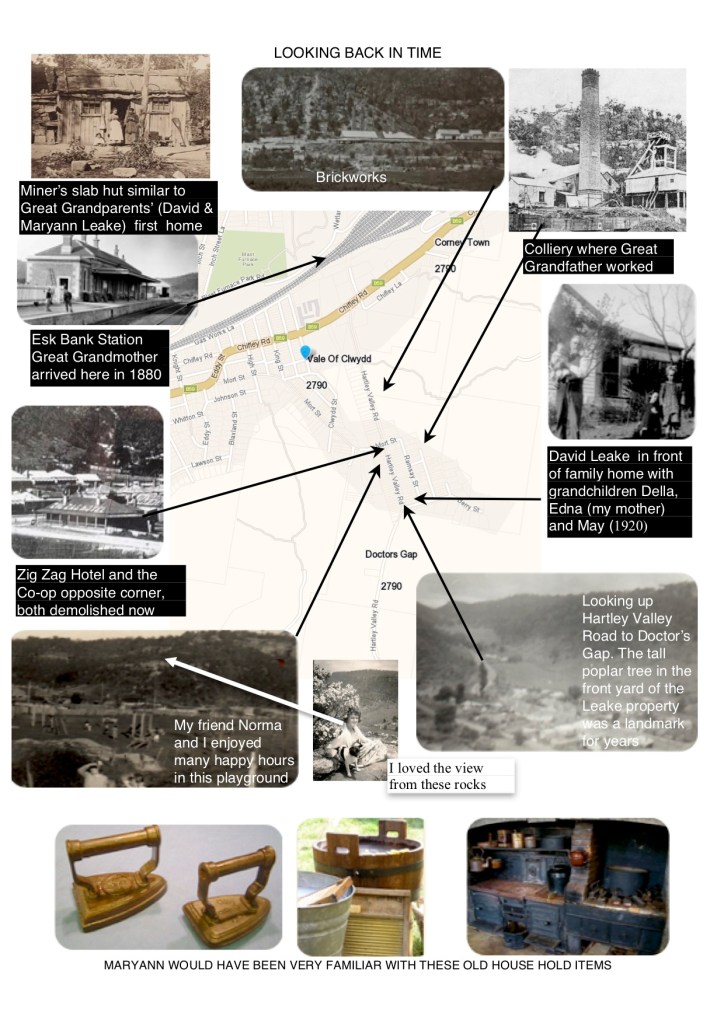
The home that David built for Mary Ann between Ramsay and Saywell Streets in the Vale of Clwydd, Lithgow, was a small weatherboard construction, with a large coal burning oven in the kitchen where the family spent most of their time; two bedrooms and a formal dining/reception room. The laundry, with its coal fired copper was in a separate lime washed brick building, next to which was the outside privy. A creek ran along the side boundary of the yard and water was originally drawn from a well sunk into the front yard.
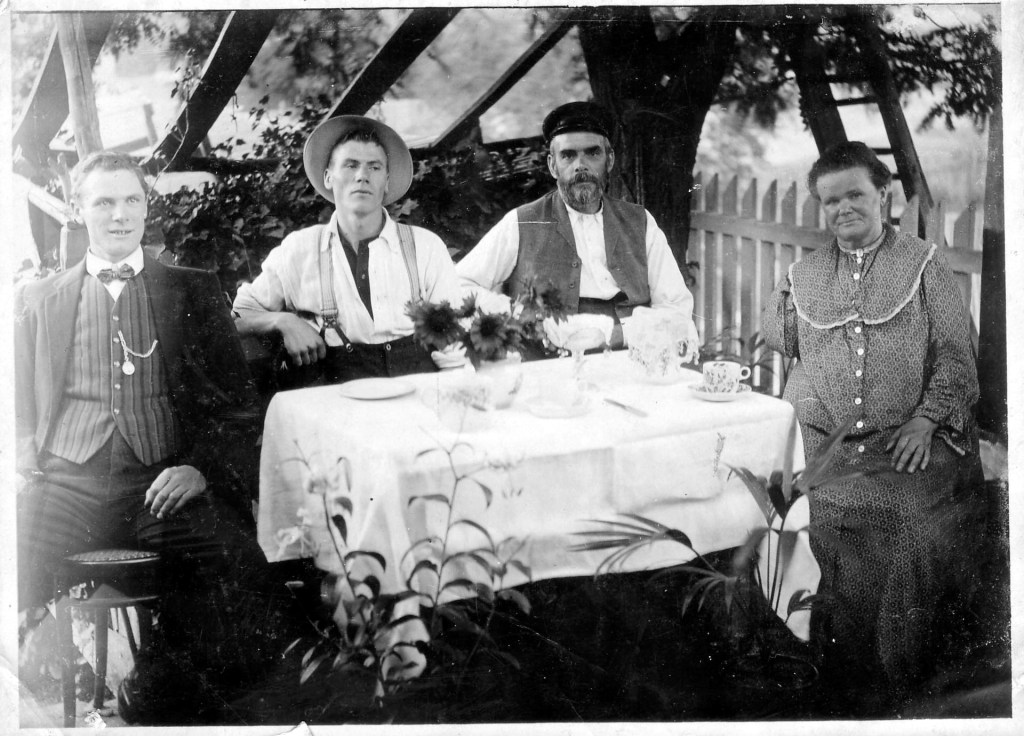
The couple must have felt nostalgic for their English landscape for they planted a poplar tree and several Hawthorne trees along the front picket fence as well as several Oak trees on the side. There are several photographs in the family album of David and Mary Ann enjoying a cup of tea while sitting beside a linen covered table, under one of the Hawthorne trees.
D
By that time, Mary Ann had lost her right arm. I was told as a young girl that a bottle of home made root beer (ginger beer?) exploded and cut her arm. The wound became gangrenous and her arm was amputated. The thought of undergoing that kind of surgery back then makes my blood run cold.
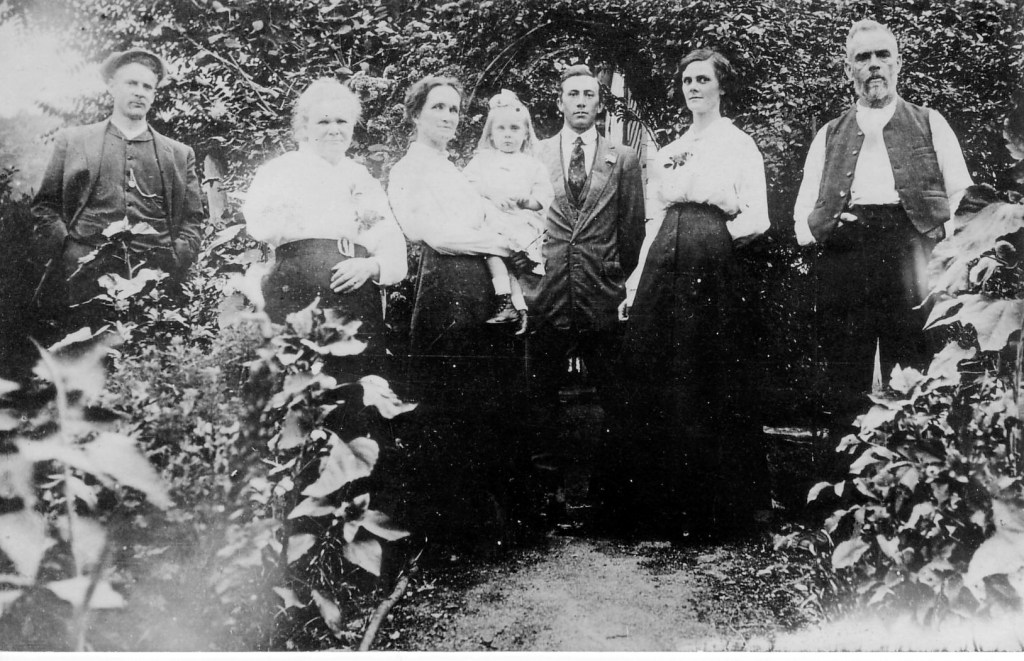
Arthur, Mary Ann, Gertrude (nee Jones) with May, Tom and Emma Sutton (nee Leake) and David C 1916
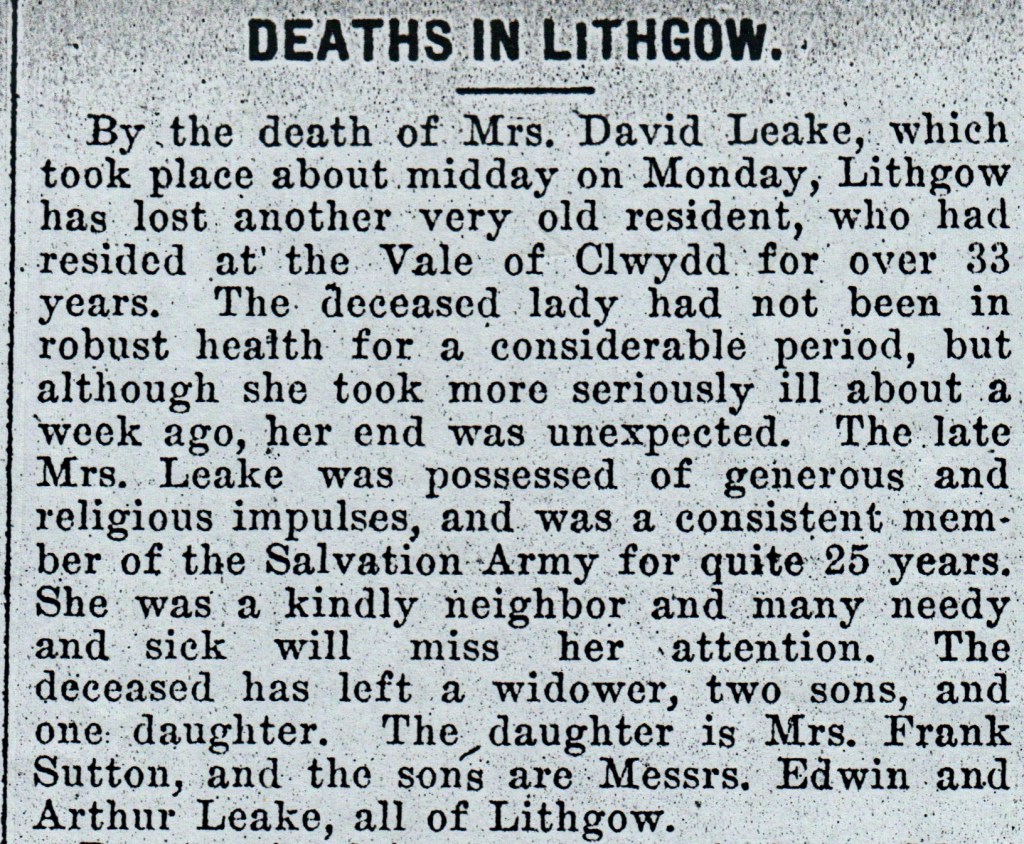
Mary Ann died during the Spanish Influenza epidemic on 23 September 1918. Her obituary, published in the Lithgow Mercury reported:
At some time after the death of his mother, Arthur Leake and his family moved into the family home with David. I recall my mother, Edna and Aunt Della reminiscing about their childhood memories:
“Remember when one of us would be asked to leave the kitchen table and go outside if we had shown any form of bad manners. Grandfather used to sit on a wooden chair beside kitchen door and he would give the recalcitrant a gentle kick as they departed.”
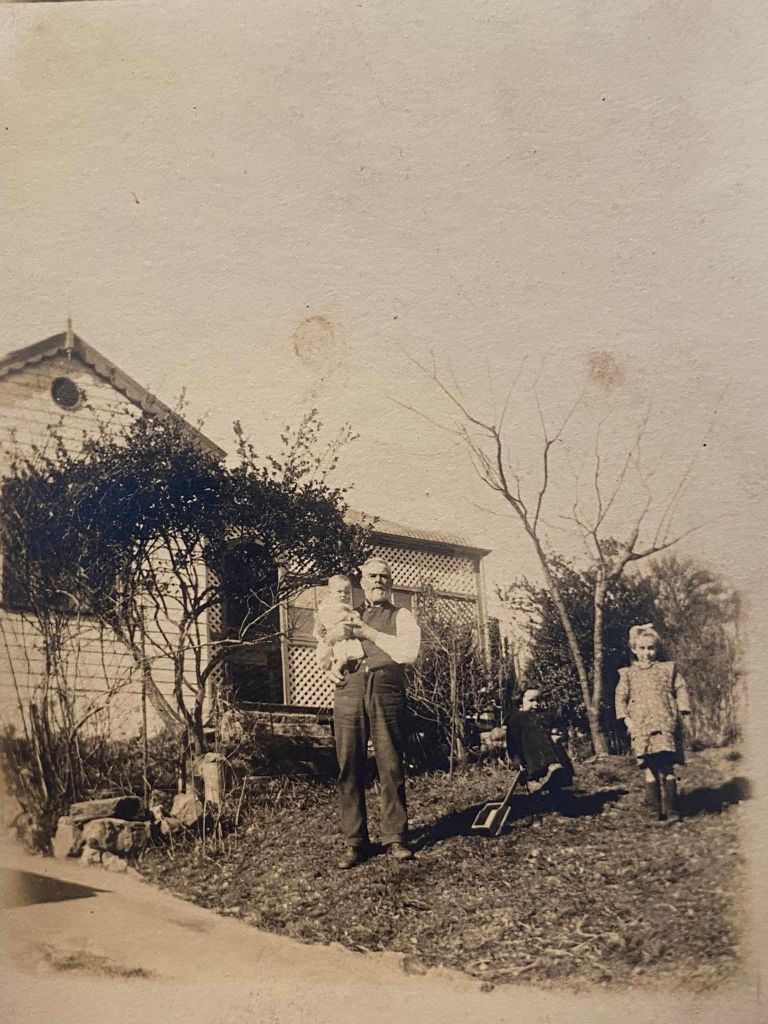
David holding Della, with my Mum, Edna and big sister May. C 1922
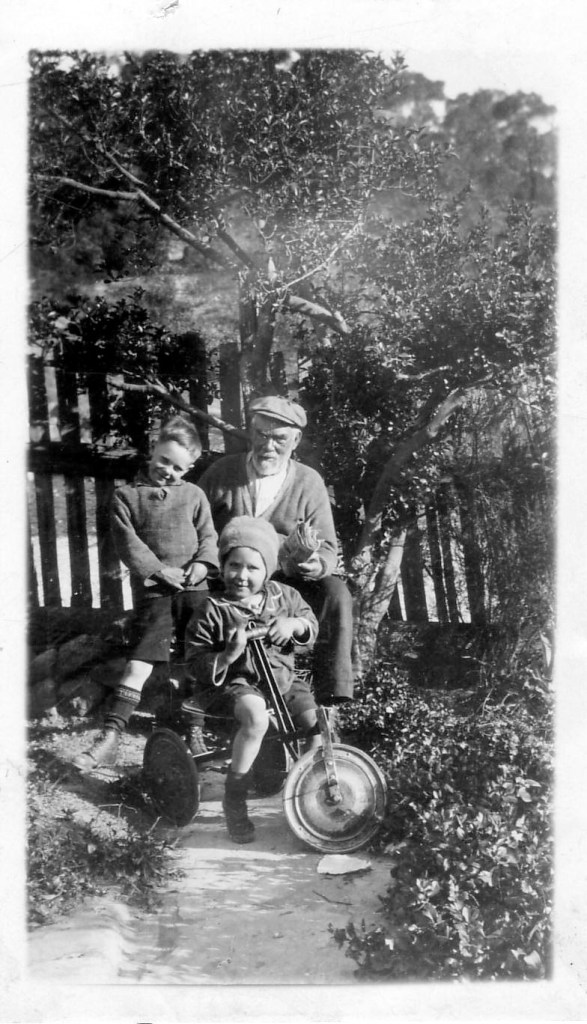
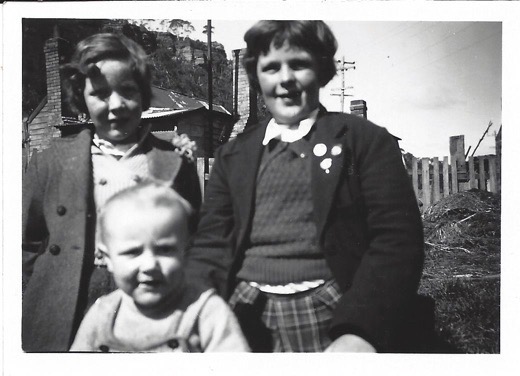
David with Arthur’s sons Clifford and Edward
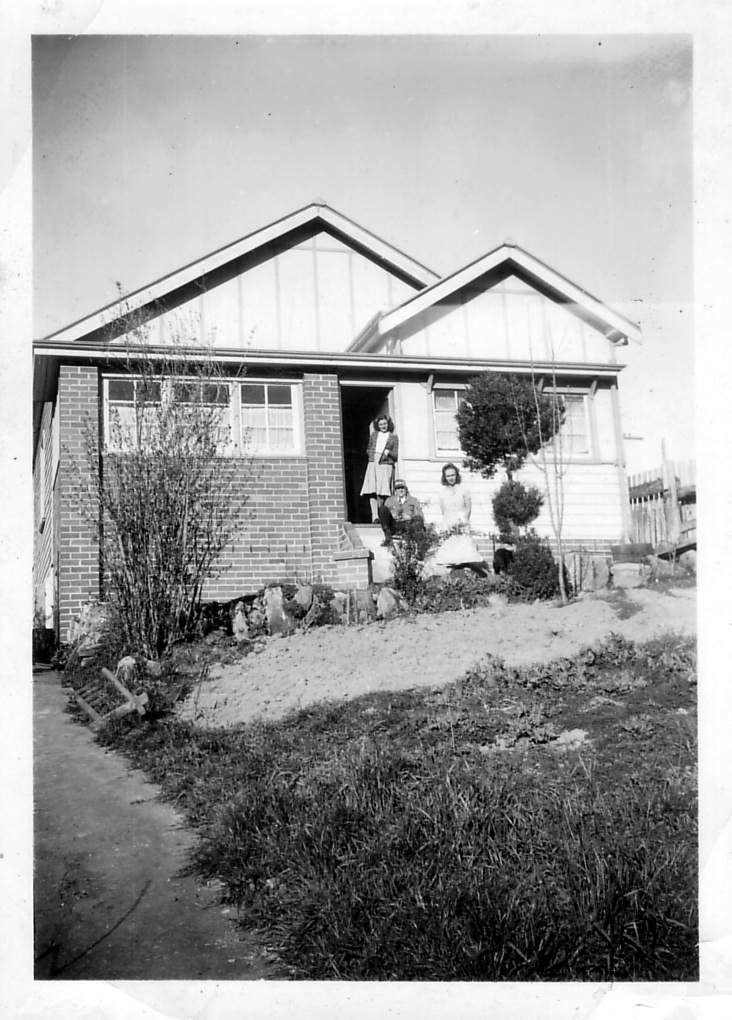
Cliff’s fiancee, Veronica (“Billy’ ) MacInolty in doorway, with Arthur and May on front steps
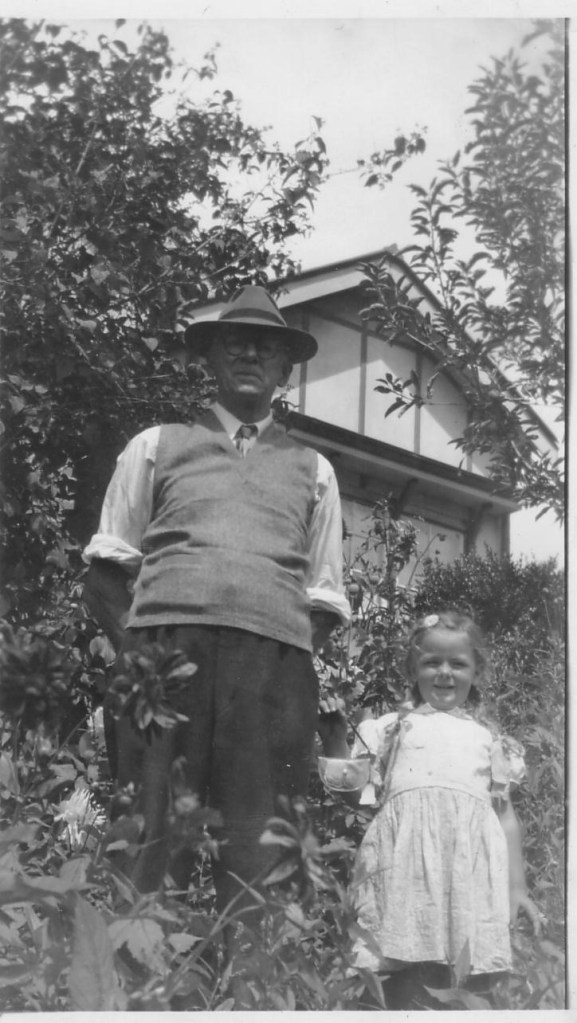
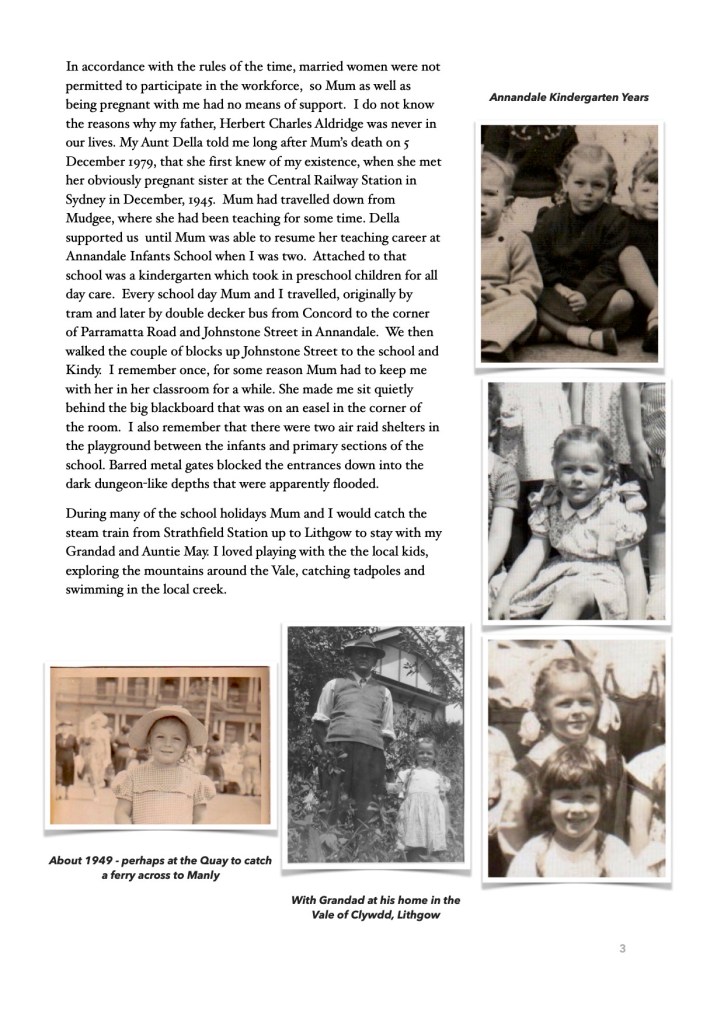
When I was young, I often stayed with my grandfather, Arthur Leake at the original family home.
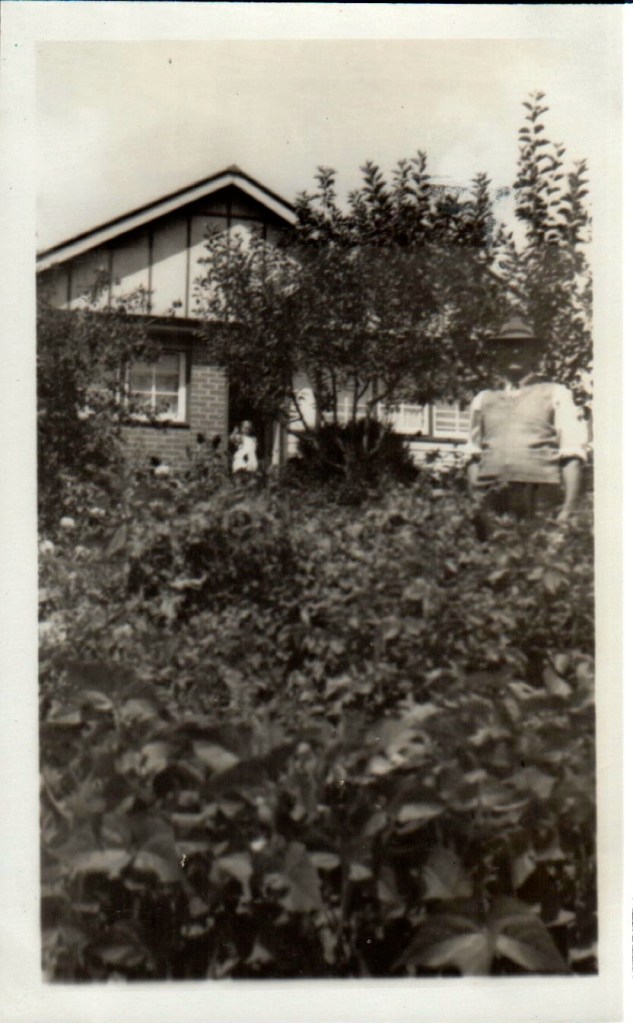
Grandfather in his garden and Susan standing on front steps of housedescription In front yard of Grandfather’s home, 1 Ramsay Street, Vale of Clywdd, Lithgow
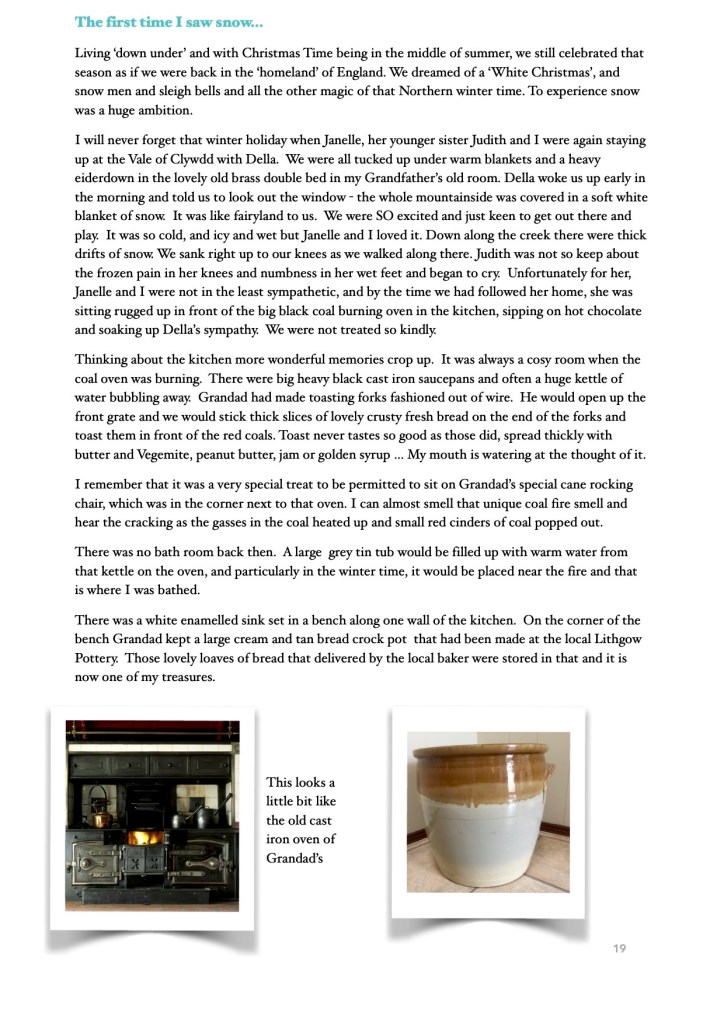
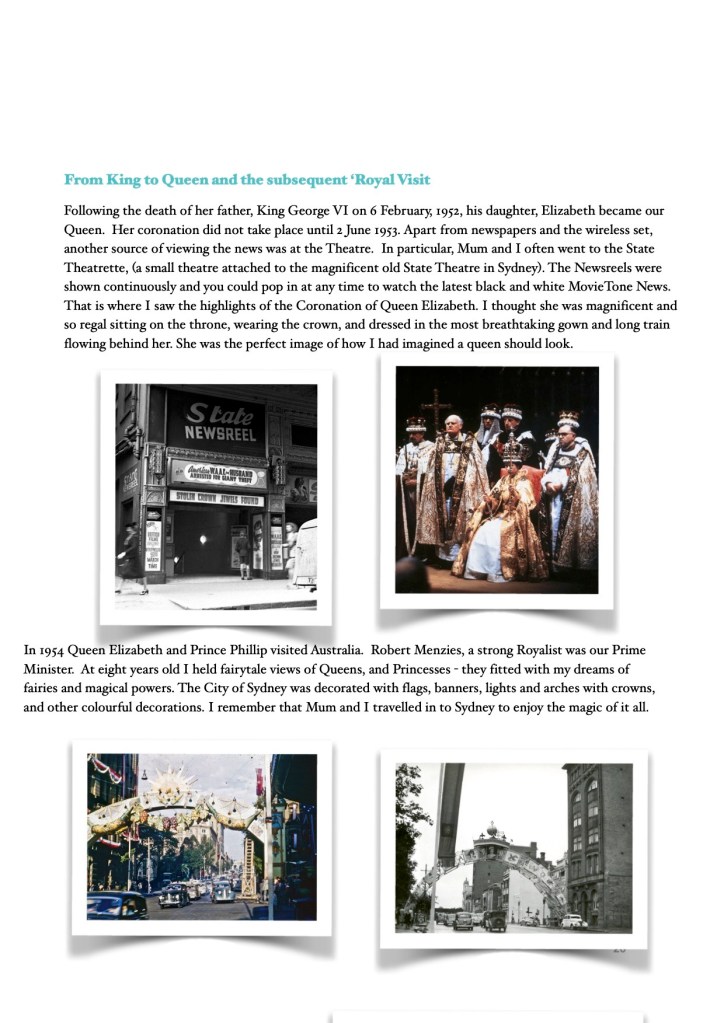
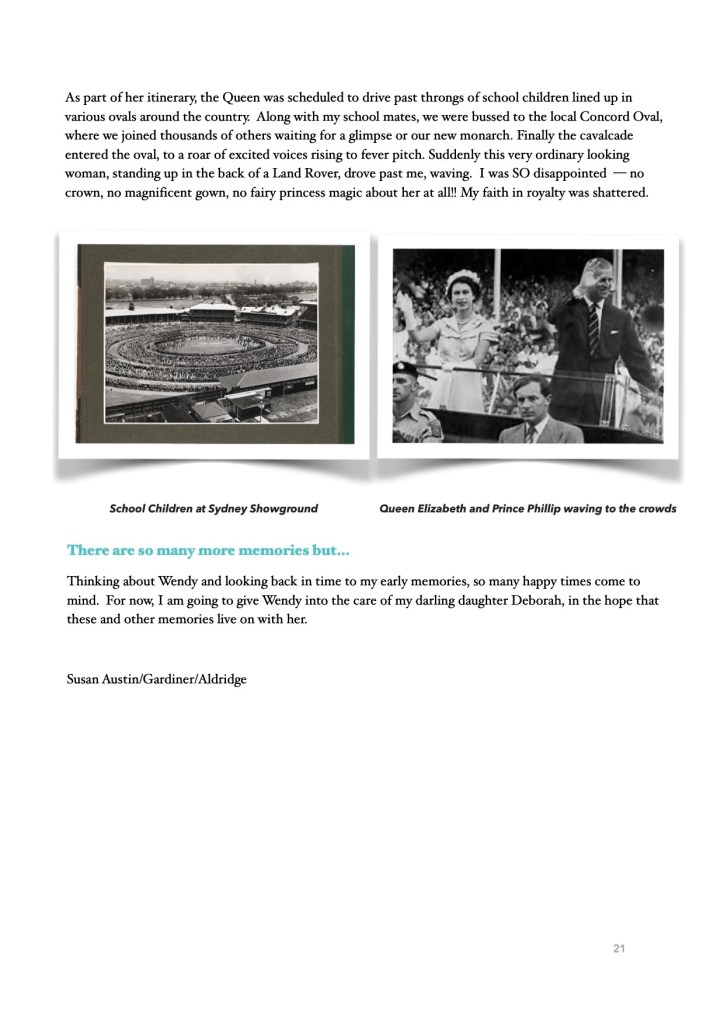
Although three more rooms had been added by then, we still spent most of our time sitting in the old original kitchen, still warmed by the coal oven that Mary Ann had used. I remember being bathed in front of the oven fire in an old metal tub filled with hot water poured from the huge black cast iron kettle that seemed to be permanently bubbling away on the oven. Another great memory is being allowed to sit on the old rocking chair in front of the fire, while toasting bread on an old fork fashioned from fencing wire.
Grandfather still used the old laundry. It was such a lovely warm place to shelter from the frosty snowy winter days that were common in the Vale. It was not such a great place to be in the height of the summer heat though. I am sure that washing day was a physically hard and long process for Mary Ann. The fire would have to be lit under the copper and the water fetched by the bucket full from the well in the front yard. The clothes then would need to be scrubbed on an old washboard, before being plunged into the copper. Mary Ann would next have to lift the heavy wet washing out of the copper, using a wooden prop stick, and feed them through a hand operated mangle into the old stone sink of rinsing water next to the copper then back through the mangle again before hanging them out on the line strung between two poles and raised by a long wooden prop. I am very glad to have all the modern machinery in my laundry.
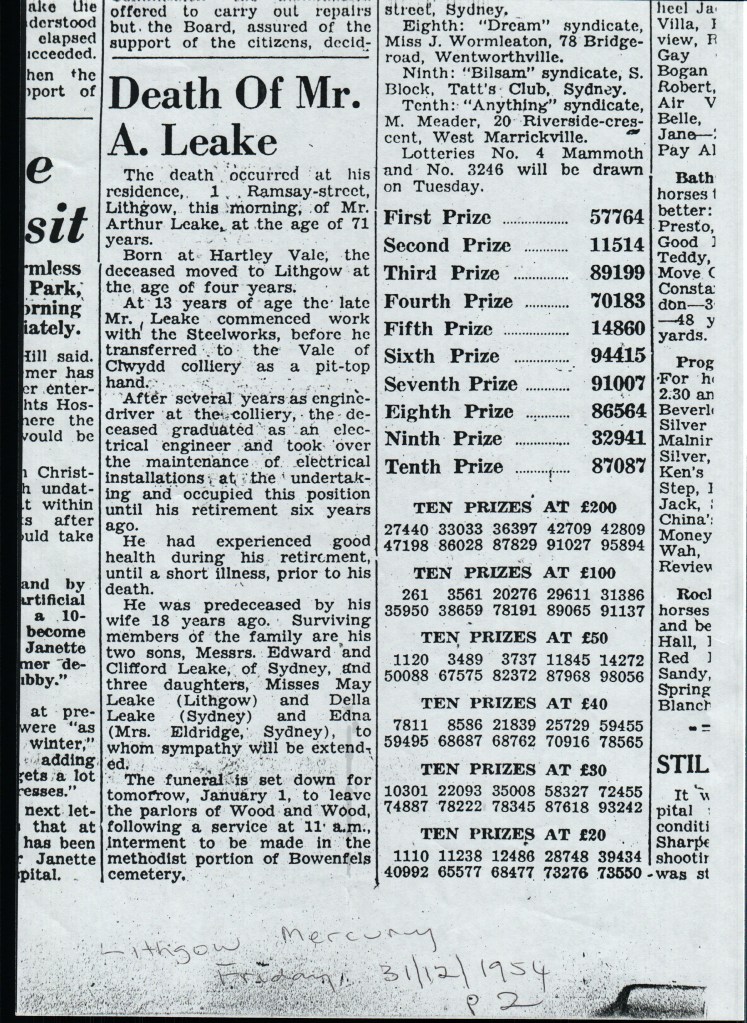
I can remember clearly the night that Grandfather passed away. My mother and I were sharing a bed in the room across the hall from his bedroom. Late that night, my Uncle Ted knocked on the door and said “He’s gone.” Although I was nearly 9 by then, I really did not grasp what he meant. The family did not include children in ‘adult’ issues of life and death, we were to be seen, not heard and never included. Grandfather just ‘disappeared’ from my life.
The Vale of Clywdd holds a special place in my heart. I have so many happy memories of times spent there staying with my Grandfather and later, after his death, my Aunt Della, who added another extension to the house.
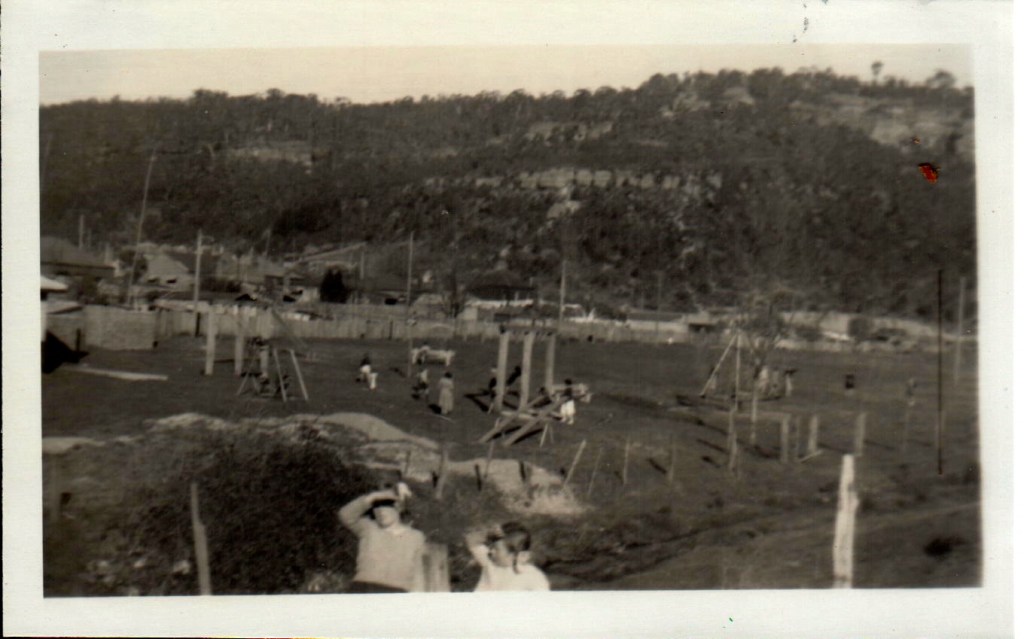
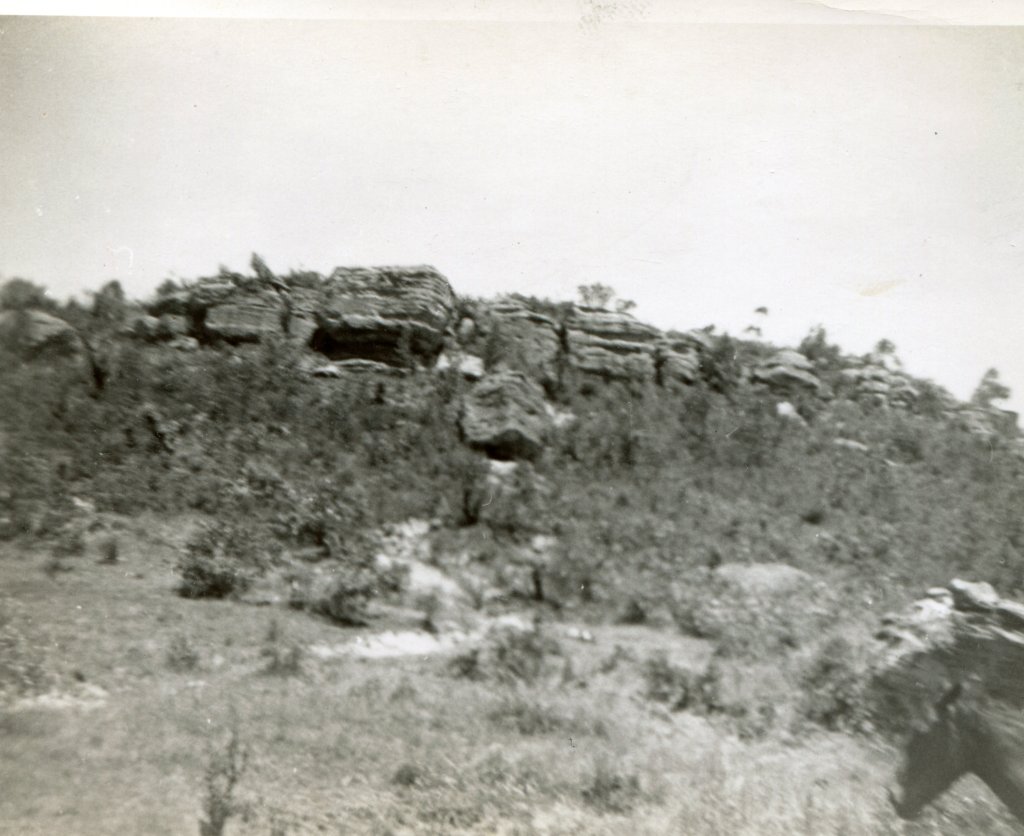
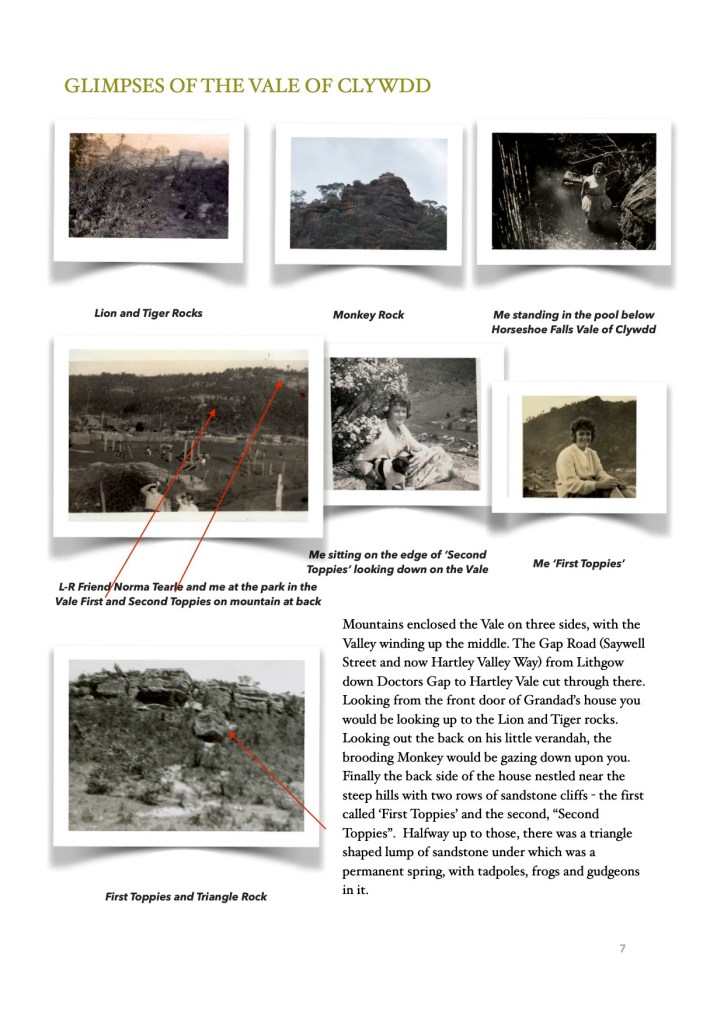
I loved playing with the local children, particularly Norma Tearle from across the road, and Norma Cowling, who lived up in Evan’s Gully. We were free to roam the Vale; climb up the adjacent mountain to ‘First and Second’ Toppies; catch tadpoles in a pond fed by a perpetual spring that ran under a triangular shaped rock below First Toppies; swim in the creek that flowed down through the paddocks to the play ground, shops and pub at the end of Saywell Street; go exploring up into Evans Gully to the cool fern lined Horseshoe Falls; and gather with the local ‘gang’ of kids under the street light at the front of Grandfather’s home in the early summer evenings to play until called home for dinner. I will never forget the fun of bonfire night, when the kids were finally able to set light to the pile of branches they had been collecting in preparation for celebrating Empire night, and later the Queen’s birthday. Norma Tearle’s older brother frightened us once, when he climbed up the mountain to the first ridge of rocks in the pitch dark, and then shone a torch through red cellophane, illuminating his face to appear like some fearsome red faced zombie.
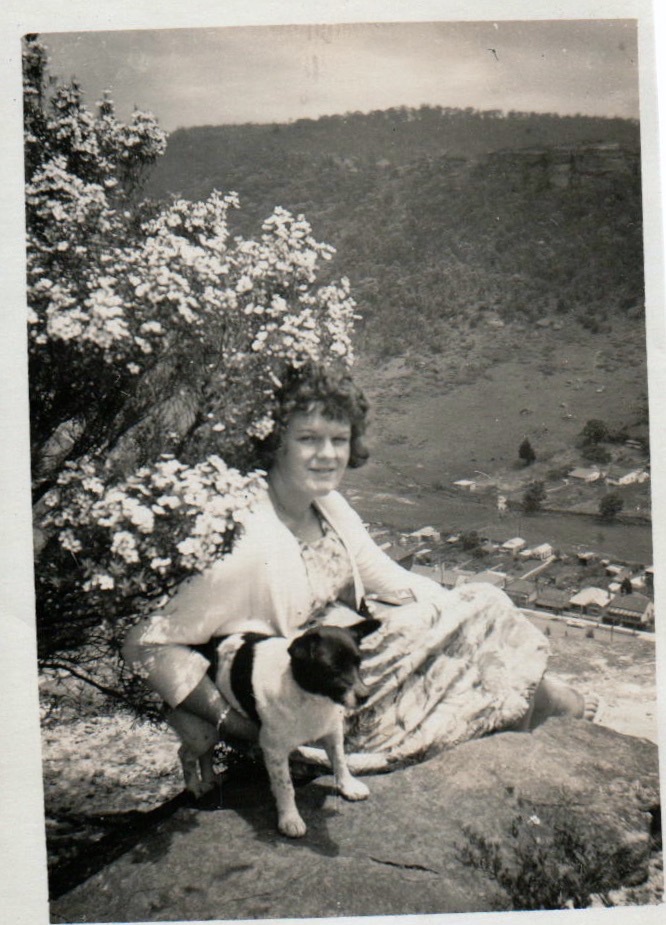
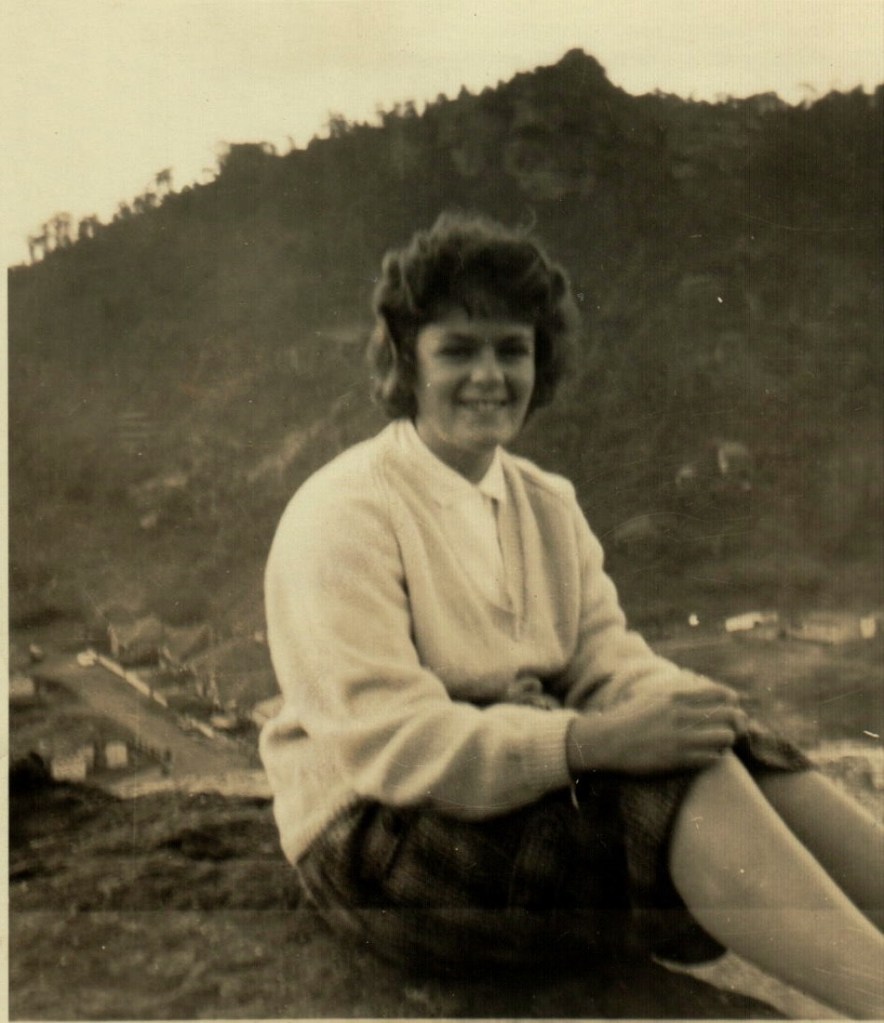
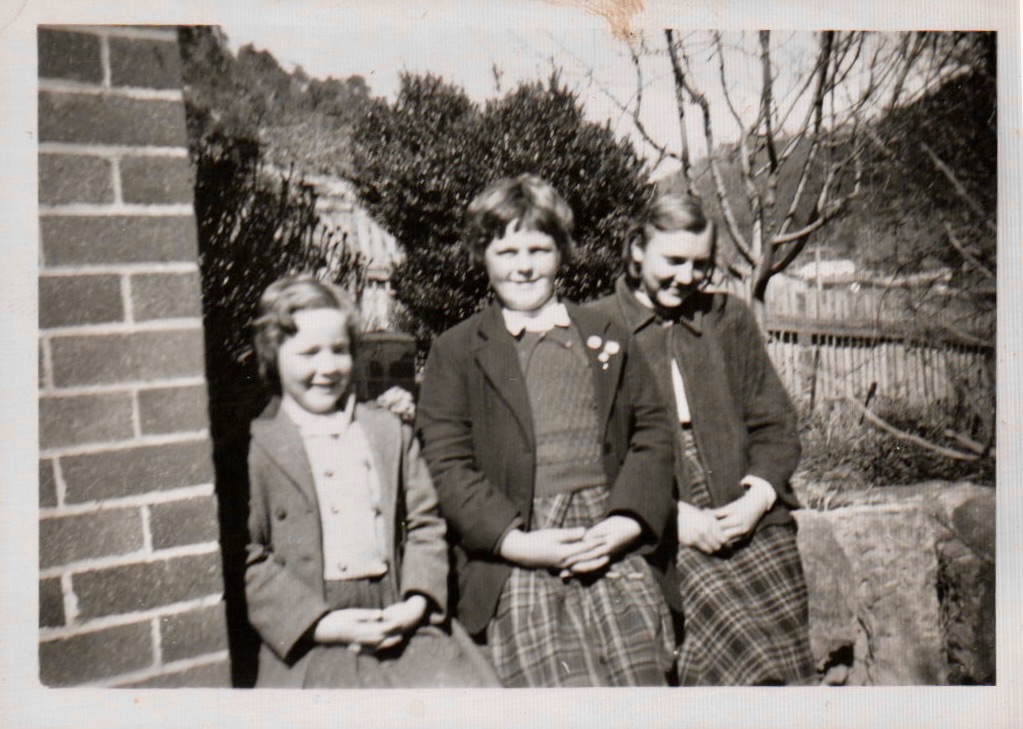
Susan and Friend NormaTearle at park in the Vale of Clywdd. Mountain in back is behind Grand father’s home. First line of rocks was called ‘First’ Toppies, and rocks above, were Second Toppies.The triangular shaped rock with tadpole poolCoral Brown and Susan AldridgeSusan on Monkey Rockover looking Vale of Clywdd some time in 1961Susan on second Toppies Valey of Clywdd
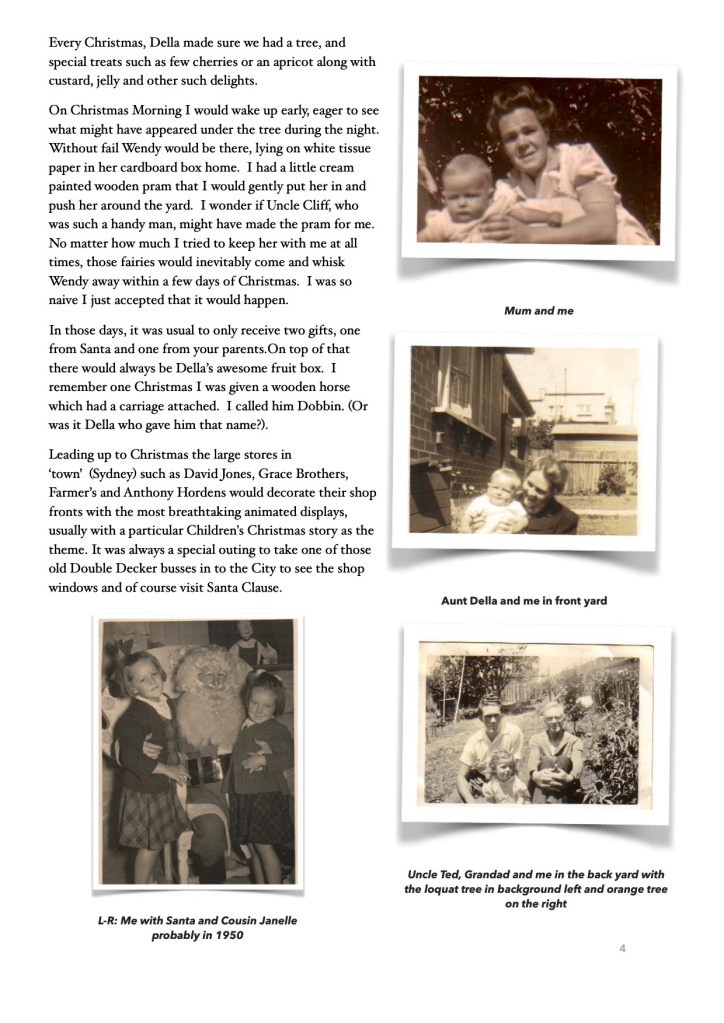
Often my Cousin Janelle (Cliff’s daughter”) joined me, particularly during the Christmas Holidays. Aunt Della set up a lovely old brass double bed in the garage, with a Christmas tree. Janelle and I would wake up on Christmas morning to a box of beautiful fresh fruit, including cherries and apricots, as well as our one special present from Santa.
Janelle and her sister Judith were with me one winter holiday when we woke to the thrill of a crisp snowy morning. It was our first experience of snow and I don’t think any of us have forgotten that special day.
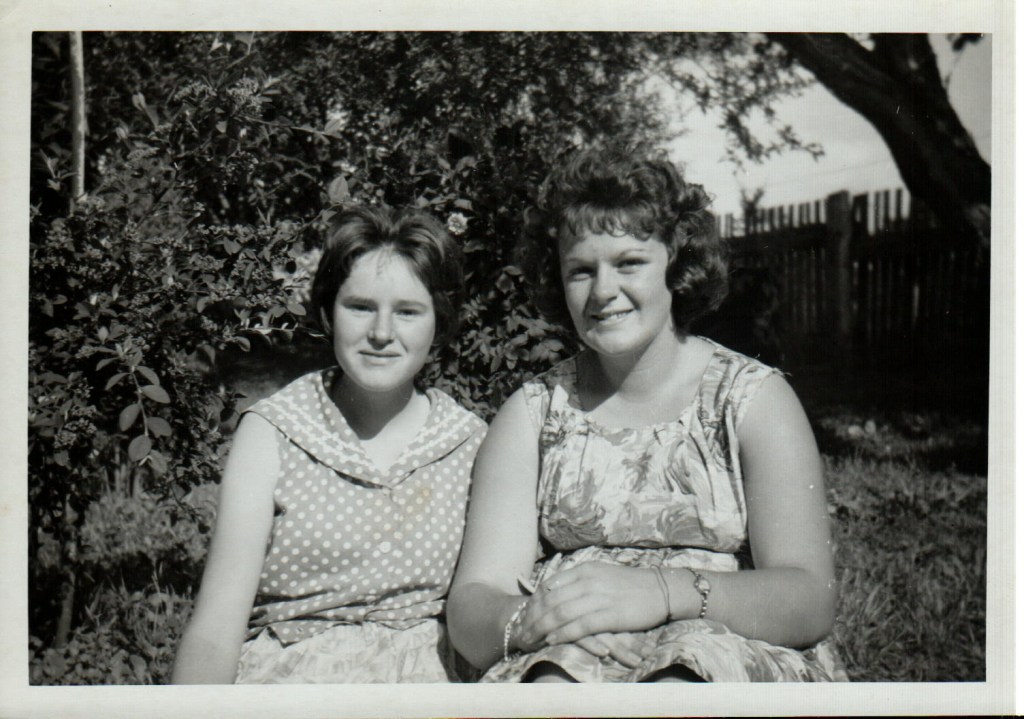
Jusith Leake, Susan Aldridge, Norma TearleJudith Leake, Susan Aldridge, Daryl Tearle in the Tearle’s yard
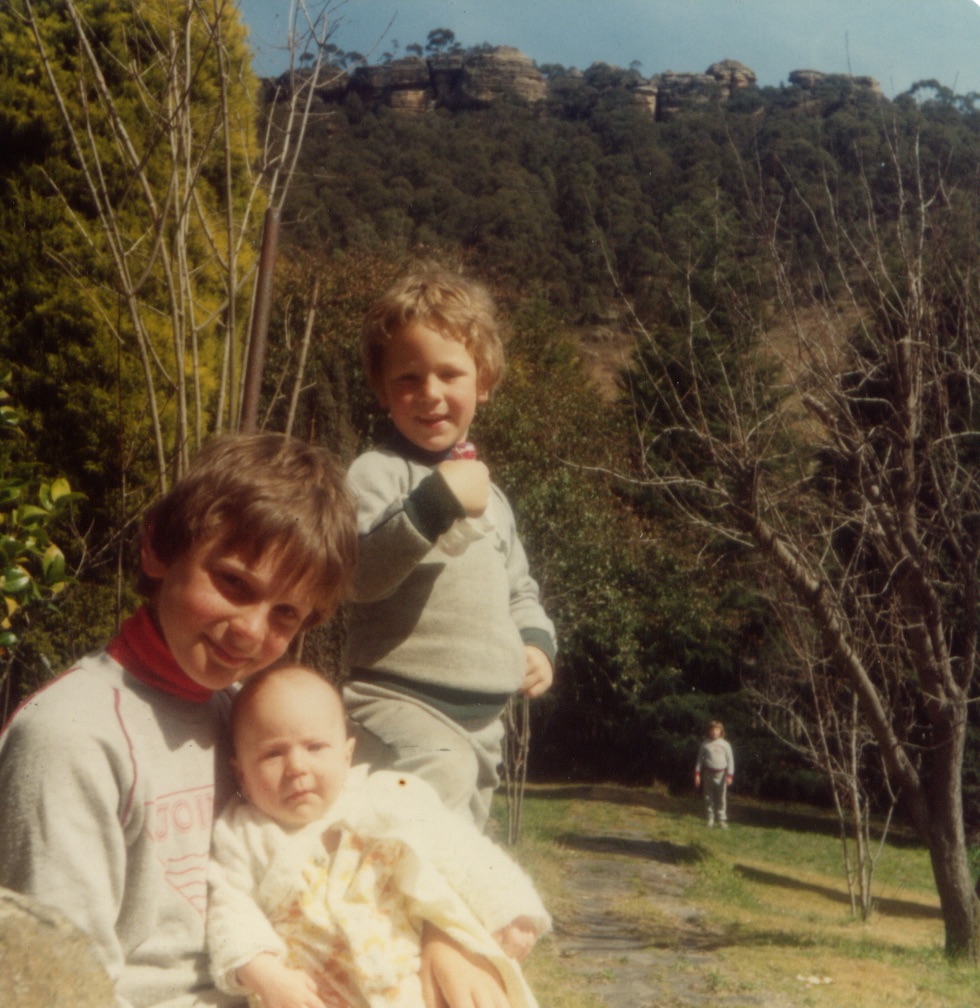
Finally, my children, David, Deborah, Antony and Jennifer Gardiner were the fifth generation to visit the old Leake home in the Vale.
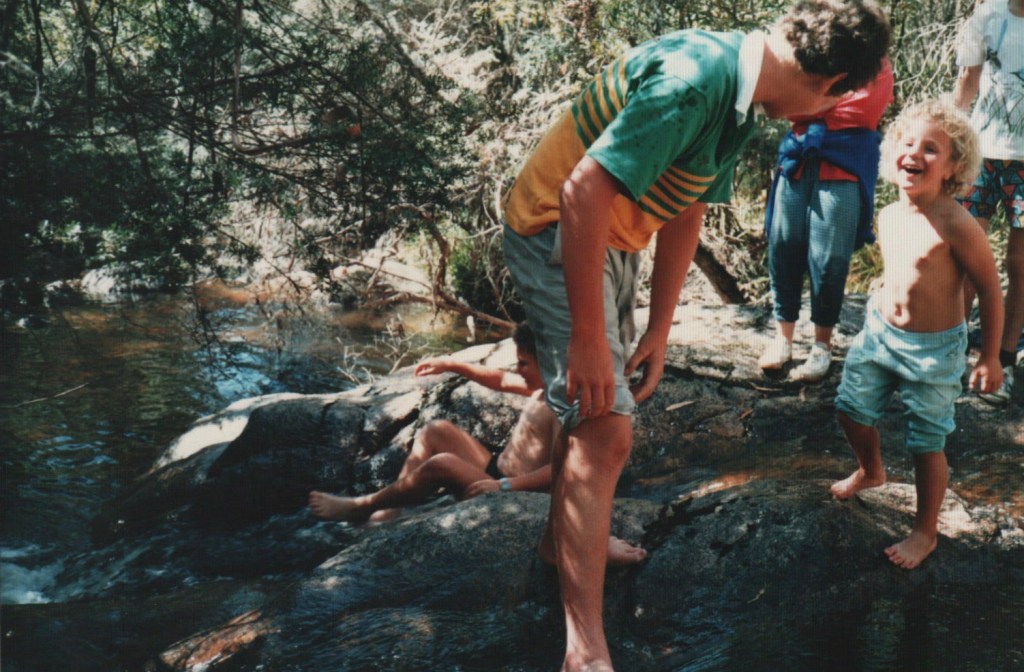
My children David, baby Jennifer, Antony and Deborah in the front yard 1981My children playing in the creek that flows from Horseshoe Falls in Evan’s Gully c 1985
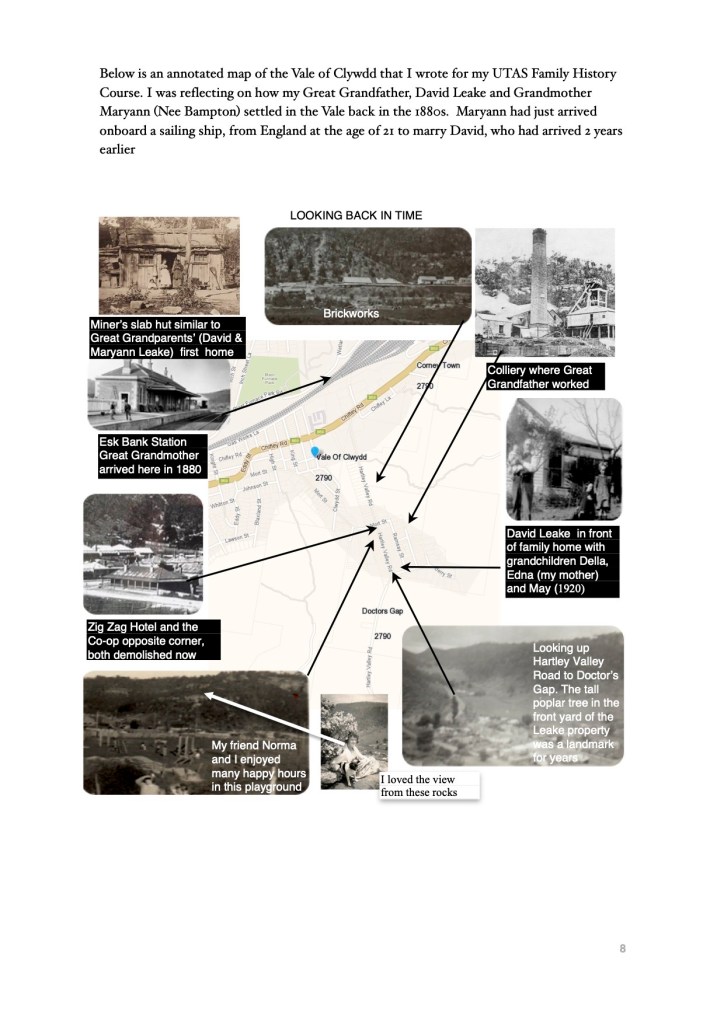
Some years ago, I created this annotated map in memory of My Great Grandparents, David and Mary Ann Leake who settled here in 1880. The home that they built remained in the family until my Aunt Della passed away in the 1980’s. I have many happy memories of times that I spent there visiting my Grandfather, (their son Arthur) and later my two Aunts, May and Della.
I have several photos of my great grandfather, David Leake. One in particular, taken towards the end of his life, draws me to him. He looks thoughtful, possibly reflecting over his life. He was born in 1856, in Staffordshire, England, the second son of coal miner, John and Mary.[1] It was a time of huge change, both socially and economically. Industrialisation, urbanisation and technological advances in agriculture had transformed the rural landscape of the country. The steam engine, a vital invention of the Industrial Revolution led to rapidly increasing demand for coal, in turn leading to dreadful working conditions in the mines.[2] ,[3] By1861, his oldest brother, eleven-year old Thomas, was already working as a collier’s labourer.
In search of a better life, John and Thomas sailed from Liverpool, arriving in New York on 10 March 1871.[4] David, now a miner, and his four younger brothers and sister remained at Ogley Hay with their mother. [5] Shortly later, they too sailed to the USA.
Tragedy struck soon after the family had reunited. Four-year old Edwin died on 15 August that year. [6] David and his surviving brothers worked with their father for the Consolidation Coal Company, until tragedy again struck the family on 20 May 1874, when John Senior became the first fatality at the mine[7]. He was buried beside Edwin, at Vale Summit MD.
Figure 2 Graves of Mary, Edwin and John Leake, Methodist Cemetery, Vale Summit MD
Within a year of his father’s death, nineteen-year old David left the family and the USA, and returned to England. A family story passed down the generations was ‘he had been involved in a physical altercation with a male friend of his Mother. Believing he had killed the man, David escaped to England’. It is likely that he chose to return to his girlfriend, Mary Ann Bampton, in his old hometown Ogley Hay[8].
Attracted by the Australian Immigration Regulations of 1876, David chose to ‘try his luck’ as an assisted immigrant. On 15 November 1877, with Mary’s brother, James, he arrived in Sydney on board the sailing ship, “La Hogue”. [9] The journey had taken 87 days and cost the boys £10 each.
“With but 25 cents in his pocket he secured a job on a farm near Sidney (sic) digging potatoes for nine-pence a sac. Making enough to journey on he wended his way into the famous New Castle coal district, where he began digging coal”.[10]
The majority of Collieries had formed a Vend, in which they managed the supply of coal to the markets and controlled the price received. Industrial relations within the Newcastle coal mining industry were in a period of harmony. [11] Wage rates were high, and miners enjoyed considerable amounts of leisure time. David was promoted to the position of ‘Check Weigh-man’, responsible for ensuring consistency in the quality and quantity of each miner’s skip load of coal. In his spare time he studied engineering over the next eight years.[12]
On Christmas Eve, 1880 Mary and her brother James’ fiancé, Ann Lawrence sailed into Sydney Harbour. The two young couples married in joint ceremonies. Although their marriage certificate is dated ‘1880’, David and Mary were married at the Wesleyan Parsonage, in The Rocks on 15 January 1881.[13] It would seem that the Minister, George Martin, had not caught up with the new-year.
The couple set up home in Hartley NSW. The completion of the railway between Sydney and Lithgow in 1869 led to increased demand for coal and in the 1880’s large-scale coal mining commenced in the Western Coal Field at Hartley Vale.[14] The family increased, with the births of three sons, Edwin (1881), Arthur (1883) and John (1886).[15] , [16],[17] Upon completion of his training the following year, David was employed at the Zig Zag Colliery, Lithgow as an Engine driver. Happiness of promotion was tempered by grief, when baby John died in 1887.[18]
David built a home for the family nestled in the Vale of Clywdd, Lithgow. That home did not pass out of family ownership until the death of his granddaughter Della in 1984[19].
The family was completed in 1893 with the birth of his only daughter Emma. [20]
When David left the Zig Zag to work at the Vale of Clywdd Colliery in 1900, he was presented with a medallion. During the presentation, it was said that “Dave” ‘was a man in the truest sense of the term’ and that ‘all found him courteous and obliging.’[21]
An active member of the Engine Drivers and Firemen’s Union, he gave some insight into his duties during a wages hearing before the Western Collieries Wages board in 1908:[22]
Figure 5 Exerpt from Lithgow Mercury, Page 1, S November 1908
In 1918 his beloved Mary died, a victim of the ‘Spanish Influenza’ epidemic. [23] Several years earlier a bottle exploded whilst she was making ginger beer. Complications to the wound, caused by diabetes, led to amputation of her right arm.[24]
Figure 4 L-R: Son, Arthur, Mary, Arthur’s wife Gertrude holding May, Son in Law,Frank Sutton, daughter Emma Sutton
David was very proud of his work safety record. However, the year before his retirement in 1921, a fatal accident occurred when an employee, was crushed by an empty skip. At the subsequent coronial inquiry, David was described as “a careful driver with long experience at the work.”[25] The coroner handed down a verdict of ‘accidental death’.
Apart from his work and family commitments, David dedicated time to the G.U.O.O.F and the Salvation Army[26].
He maintained regular contact with his family in USA. On 28 February 1924 David sailed from Sydney to San Francisco on board HMS “Tahiti”.[27] Reports of his reunion with his brothers appeared in several publications, including:
In retirement, David spent time with his young grand children. Edna and Della reminisced about times, when asked to leave the kitchen table (where the family ate), a recalcitrant child would have to pass him, sitting on a chair near the door. If he felt their behaviour warranted it, he would help them on their way with a gentle kick![28]
In 1931, whilst walking near a park, David was attacked from behind by an inebriated man 30 years his junior.[29] The younger man was no match for David, who apparently punched him in the nose, and after pushing him to the ground, sat on him until two young men ran to his aid
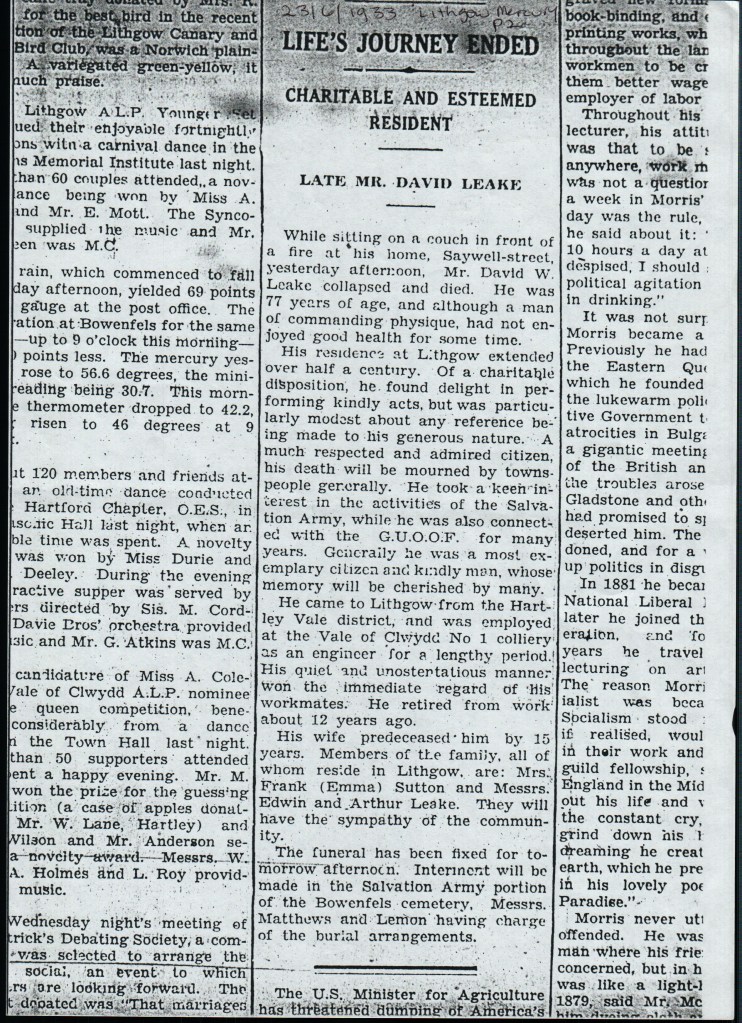
On 22 June 1933, David suffered a heart attack and passed away at his home. [30] He was laid to rest beside Mary in the Salvation Army Section, at Bowenfells Cemetery.
Bibliography
Christison, Ray, ‘A Light in the Vale Development of the Lithgow District Miner’s Mutual Protective Association 1875 – 1900’ The City of Greater Lithgow Mining Museum, 2011.
Christison, Ray and Parry, Naomi, ‘Lithgow Migration History’, Lithgow City Council and NSW Migration Heritage Centre, 2014.
1861 England Census, Staffordshire, Burntood Edial and Woodhouses, Ancestry Accessed 18 August 2018.
1871 England Census, Ogley Hay Ancestry Acessed 10 August 2018.
1924 US Department of Labor Immigration Services, List or Manifest of Alien Passengers, Ancestry, Accessed 24 August 2018.
[1]Ancestry, Census record for David Leake, ‘1861 England Census, Burntwood Edial and Woodhouses,Staffordshire’ Class: RG 9; Piece: 1973; Folio: 71; Page: 5; GSU roll: 542896, Accessed 9 September 2018.
[7] ‘Brothers are Reunited after Half a Century’ Cumberland Evening Times, 6 May 1924 Page 1.
[8] Ancestry, England Census for William Bampton, Staffordshire, Ogley Hay, Class: RG10; Piece: 2916; Folio: 6; Page: 5; GSU roll: 836406, Accessed 22 September 2018.
[9] Sydney Morning Herald 16/11/1877 P 10. AND State Records Authority of New South Wales; Kingswood New South Wales, Australia; Persons on bounty ships to Sydney, Newcastle, and Moreton Bay (Board’s Immigrant Lists); Series: 5317; Reel: 2488.
[10] ‘Brothers are Reunited after Half a Century’ Cumberland Evening Times, 6 May 1924 Page 1.
[12] ‘Brothers are Reunited after Half a Century’, Cumberland Evening Times.
[13] Marriage Certificate, David Leake and Mary Ann Bampton, Registrar of Births, Deaths and Marriages, New South Wales, 1880/49.
[14] Christison, Ray “A Light in the Vale: Development of the Lithgow District Miners’ Mutual Protective Association 1875-1900”, The City of Greater Lithgow Mining Museum Inc for High Ground Press, 2011.
The Blue Mountains were a significant barrier to the development of rail travel to the west of NSW. The railway line had only reached Lithgow in 1869, following the construction of the section known as the ‘Zig Zag’ built to allow the steam trains to descend the steep terrain leading down into the Lithgow Valley from the western side of the mountains. In the early 1860’s the ‘Little’ Zig Zag, or Lapstone Zig Zag had been constructed to climb the eastern side of the Blue Mountains. It took the steam locomotives about 6 hours to haul the train from Sydney up to Lithgow.
The same year that Mary Ann and David travelled up to Lithgow, a lyrical report written by a subscriber identified as C.H.W.H’ was published in the Sydney Daily Telegraph on 18 September 1880, page 6. :
“From the moment that those charming suburbs, Ashfield, Croydon, Burwood and Homebush, are reached until the train stops at the end of its destination through the mountains, the eye of the traveller revels in scenes picturesque and sublimely beautiful.”
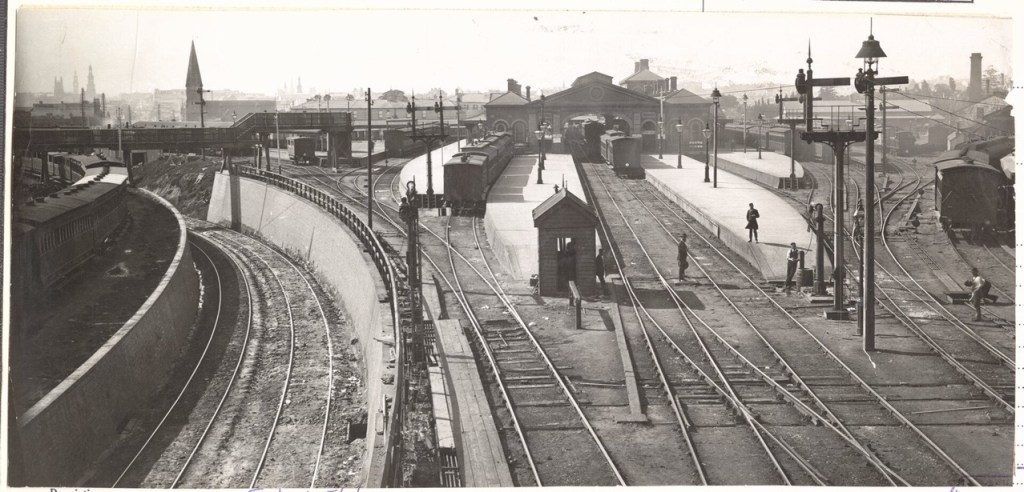
It was probably the day after their wedding that Mary Ann, dressed in her travelling outfit similar to the photo below and David made their way to the Railway terminal known as Redfern.
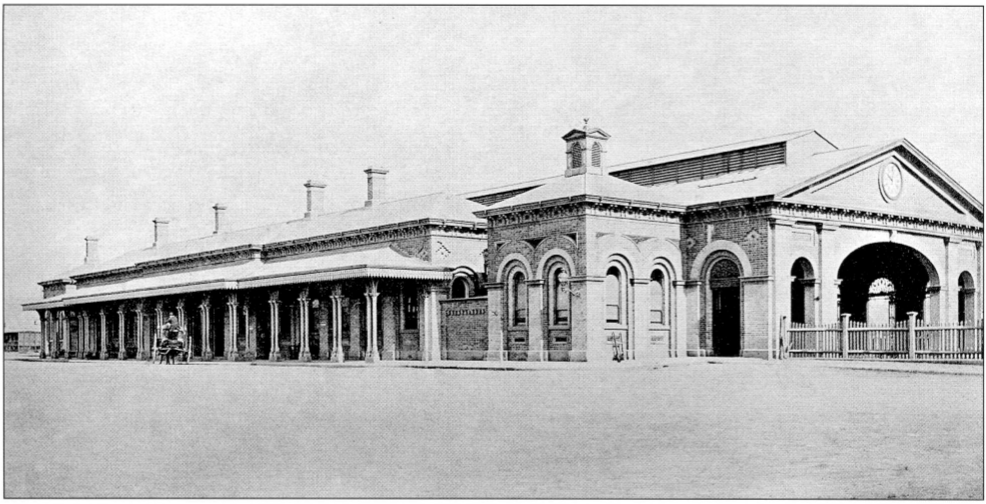
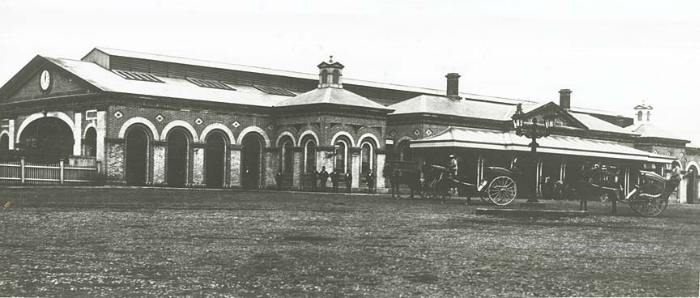
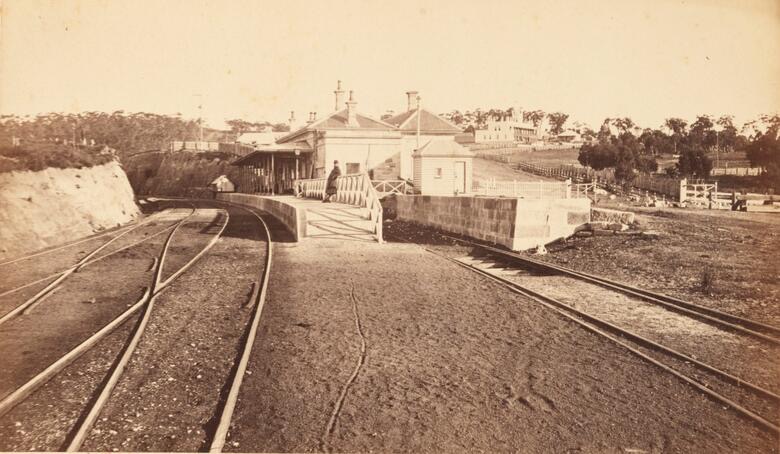
They may have hired a horse and buggy driver to transport Mary Ann’s trunk and other luggage to the station. The impressive brick and stone building had been built in 1874 on the site of the original temporary tin shed terminal located in the Government Paddocks between Devonshire and Cleveland Streets.Although it was sometimes referred to as ‘Redfern Station’, it was located to the northern boundary of Redfern.
Eastern Side (departure side) of the second Sydney railway station c 1879 NSW State Archives and Records
The train was at the platform when Mary and David arrived at the station . They were met by a porter dressed in a smart railway uniform., who efficiently relieved them of their luggage and wheeled it away on a trolley, to be stowed in the luggage carriage at the rear of the train.
David took her elbow and helped his wife up into the second class carriage. Waiting for the last leg of her long journey to begin, Mary Ann gazed out of the window taking in the vision of the recently completed platform. She thought how fitting it was that her epic journey had begun and ended in a steam train. Promptly at 9am, with a throaty whistle followed by the chuffing sound of steam, the mighty locomotive slowly rolled out of the station
Second Sydney Sydney, terminal, 1884. State Archives Collection NRS-17420-2-25-842/042
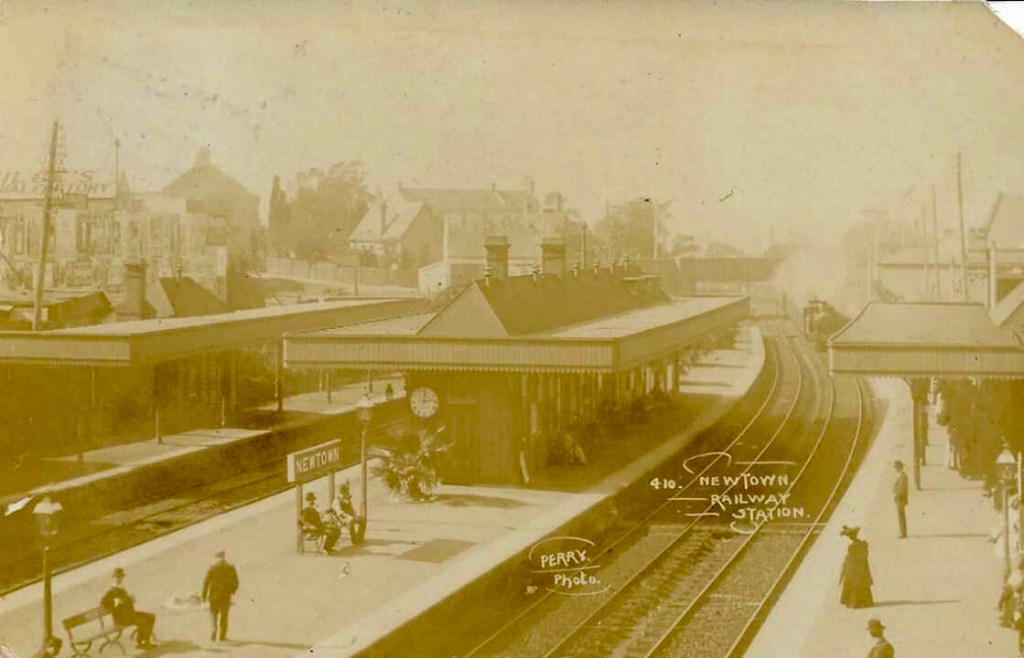
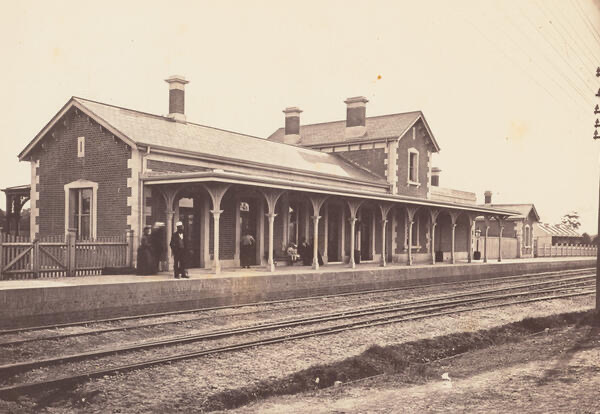
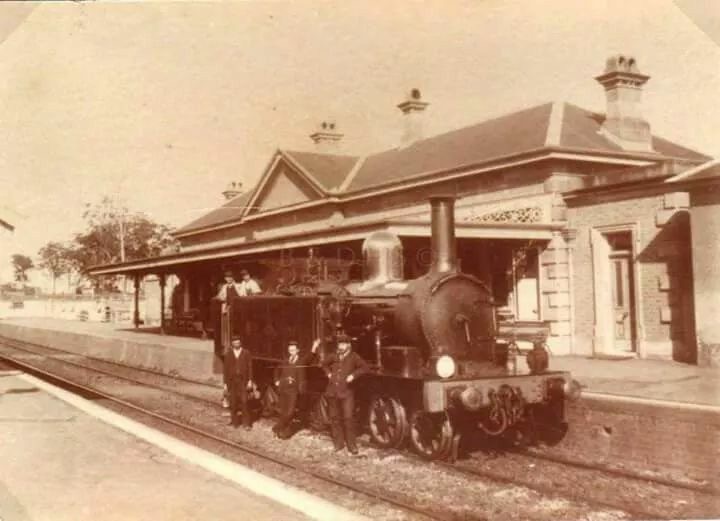
The train proceeded rapidly through the inner suburbs of Newtown, Ashfield Burwood and Redmyre (later Strathfield) with views of the back yards of many homes built beside the railway line.
NEWTOWN
ASHFIELD
‘C.W.H’ described the landscape near Parramatta as:
“orchards, flower-gardens and orange groves shed their bloom; and, as the train flies through this cultivated locality, odours, of orange flower and spice greet one from time to time,.”
At the time that Mary Ann passed through, the orange trees may have been laden with golden fruit.
PARRAMATTA
As they proceeded further westwards, from Parramatta to Penrith, the country side became less and less densely inhabited, with scattered villages along the way; a yineyard, and paddocks with market gardens, chickens, cattle and horses grazing.
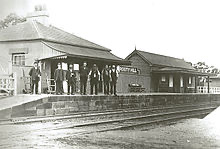
BLACKTOWN
At Blacktown the first glimpses of the distant Blue Mountains appeared
“shrouded in ethereal loveliness, rising tier upon tier, robed in royal purple…bedizened with golden sunshine streaming down upon them from cloudless skies, their deep gorges, ravines and valleys enveloped in mystic shadow..”.reported C.H.W.H on page 6 in the Daily Telegraph 18 September 1880:
ROOTY HILL
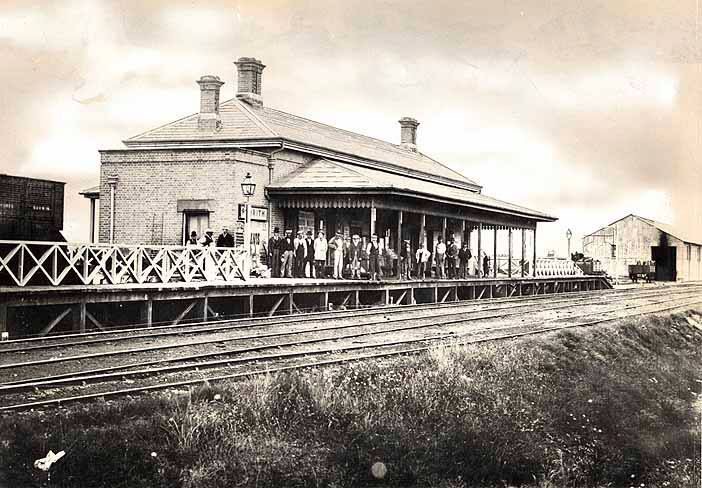
After having travelled some thirty seven miles (about 60 kilometres) the train pulled into Penrith Railway Station.
PENRITH
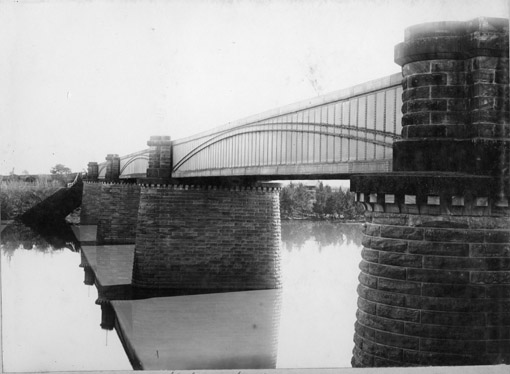
Soon after leaving Penrith they rattled over the Victoria Bridge across the Nepean River at the foot of the Blue Mountains Ridge. Over the metal sides of the bridge, Mary Ann caught glimpses of the river, studded on either side of its banks with comfortable dwellings, surrounded with orchards and large areas of cultivated land.
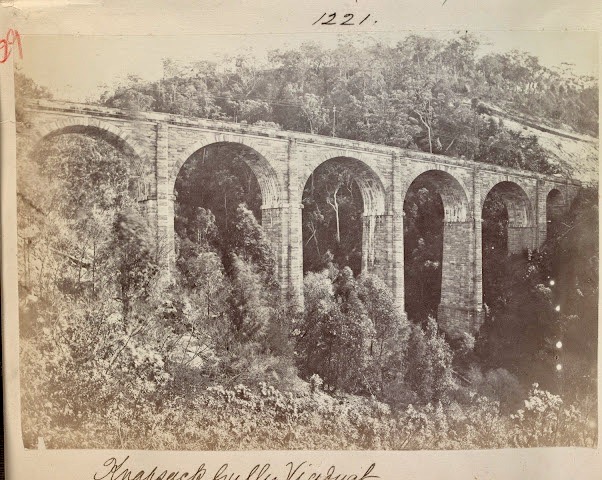
On the other side of the river, approaching the ‘Little Zig Zag from Emu Plains, Mary Ann caught her breath in awe as she glimpsed the impressive stone viaduct over Knapsack Gully ahead to her left..
KNAPSACK GULLY Viaduct Emu Plains 1877c State Library of Victoria
Pulling the train up the steep incline to the “Blue Mountains” the engine worked very hard. In an article published on page 22 in the Australian Town and Country Journal (Sydney NSW) on 22 November 1879, a ‘Special Reporter’ described their experience
“Higher and higher we mount the ranges, on many points of which have been build nice cottages and mansions, which during the summer months are occupied by many of the leading families of the colony, who seek in the pure mountains air a healthy restorative… On either side of the line the trees are sending forth new shoots; the various kinds of eucalypti are budding; the undergrowth is full of beautiful and variegated flowers, amongst which the noble Waratah is conspicuous …”
Mary Ann would also have seen swaths of rocky, scrubby, dry country and enjoyed glimpses of impressively scenic. rocky gorges, with tree ferns, mosses and maiden hair ferns growing in the damper shadier gorges. It would have felt so unfamiliar and at times challenging.
On page 88 in the Sydney Mail and New South Wales Advertiser dated 20 July 1878 a cpmntiobiuter by the name of ‘The Sketcher’ described their experience as follows:
“The Blue Mountain line is very tortuous. We go in all directions; sometimes the sun is on the right side and sometimes on the left, as we sweep along the sharp curves, the presence of which the traveller is uncomfortably made aware by being swung off his legs if he happens to be standing. This mountain railroad is wonderfully level when we consider that it leads us at least to a height of more than 3000 feet above sea level, and, excepting on the zigzags, if a person were to walk it he would not find the ascent the least burdensome. Still up we go, though we hardly know it, the faithful telegraph wires keeping us company. Glimpses of stupendous scenery are faithfully caught as we speed along, to be lost again as the grand panorama unrolls itself before the eye. No sooner do we settle down to survey some of the wildest scenes in nature than a jutting rock, or the section of a cutting, provokingly shuts all from view, and we are left to meditate, as best we can, on a disappointment which represents many other things in life. Stately forest trees, as at Springwood, indicate the richness of the soil; beautiful wild flowers, such as epacris and aoacia, even now lift up their heads in the pure mountain air ; mosses and ferns abound as we advance upward, and swamps now and then appear which seem to have no outlet. We pass the head waters of many a grim gully sloping rapidly downward from beneath our feet, and soon lost to sight in the gloomy depths of the gum trees, over the leafy crown of which the eye travels far, until bounded in the distance by a deep shade of blue. At Katoomba station one of the two engines that dragged our train was left behind, its services being no longer required
Further in the article published in the Sydney Daily Telegraph in September 1880, C.H.W.H reported: upon reaching Katoomba:
“At Katoomba there is nothing in the form of an inn or other public house …. whatever. At all but one of the other stations on the line there are – although many of them are of the rudest description. and the charges for their use exorbitantly high. Blackheath is the next station to Katoomba. Here a platform is the only accommodation for passengers entering or leaving the train. A great many persons stop at this place for the purpose of visiting Govet’s Leap … Govet’s Lcap is about four miles from the railway station, and six miles from Mount Vittoria as it was named — Victoria, it is called. Of Govet’s Leap wild tales are told. This is of course, to heighten the interest attaching to the spot. One of the stories related to me by a mountaineer is quite sensational. It is as follows:-in the days when New South Wales was the reservoir of European convicts, a desperate criminal, laden with fetters, escaped from imprisonment and made his way to the Blue Mountains. He was pursued and overtaken at the pass now celebrated as Govet’s Leap. To avoid recapture, so the story goes, this daring man leapt into the abyss and was never heard of or seen afterwards. Another tale, much more probably the true one asserts that a surveyor named Govet came so suddenly upon this inaccessible mountain gorge that he would have fallen, headlong down the precipice had he not taken a desperate leap on to an intervening crag and to perpetuate this act of bravery his companion named the spot Covet’s Leap.”
I wonder if David knew that tale and shared it with Mary Ann as they continued on their way.
Arriving at Mt Victoria at about 2pm, the train paused for about 20 minutes to allow the probably famished passengers to have something to eat at the refreshment rooms on the station. Although, given the short time and number of passengers not everybody may have been served in that time. In the Sydney Mail, 20 July 1878 a contributor referred to as ‘The Sketcher’ reported on page 88 that:
“A tidy refreshment-room close to the station afforded every accommodation that was needed. But, through the rush being greater than perhaps it was expected to be, the attendance of the waiters was not so brisk as it might have been, and I soon found that I should have to dine on atmospheric air, if I had not waylaid a waiter and served myself. “
Mt Victoria Station 1879 extended to include refreshment room SLNSW PXA1109-15 – Mount Victoria Station
C.H.W.H concluded their article in the Telegraph with a deeply felt account of the descent via the Zig Zag into the Lithgow Valley:
“A few miles journey from the Mount brings the traveller to the far famed Zig Zag beginning with the viaduct, above Clarence tunnel, placed at an altitude of seven hundred feet above the level of the valley in which it begins. Clarence’s Tunnel is a quarter of a mile in length. The circuitous descent from the mountain side has a very singular effect upon the traveler’s nervous system: per perpetually winding and whirling as it seems now hanging on the extreme verge of the mountain gorge, where the slightest deviation from the narrow and precipitous way would hurl the train into an abyss hundreds of feet below, which certain destruction would be more to follow an occasion some trouble in the gazer’s mind. The vibratory motion from the continual shunting of the train, necessary to the sinking from one line to another is extremely disagreeable -the banging and a sense of falling being most unpleasant. There are two tunnels on the ZigZag.
The level of the valley below the Zigzag gained, a steam of about 20 minutes brings the train into Litbgow, and 10 minutes more to Bowenfells station. The scenery through which the Zig Zag winds, is some of the grandest on the Blue Mountains. The winding valley is enclosed in tremendous walls and jutting crags of solid rock between the fissures of which grow the most magnificent trees and shrubs to be found in this wilderness teeming with the beautiful. The flora of the Blue Mountains are magnificent and various, and here about the Zig-zag the most splendid specimens abound. It has been said that these flowers are without perfume, but it is a mistake. The air is often fragrant with their delicious odours. The zoology these wilds comprises only opossums, wild cats, rats, and of birds, magpies, cockatoos and kingfishers “
After such a dramatic conclusion to her journey, I imagine that Mary Ann must have felt immensely relieved to finally have reached her destination. Now it was time for her to truely begin the next part of her life and join her husband in setting up their home together in the Vale of Clwydd.
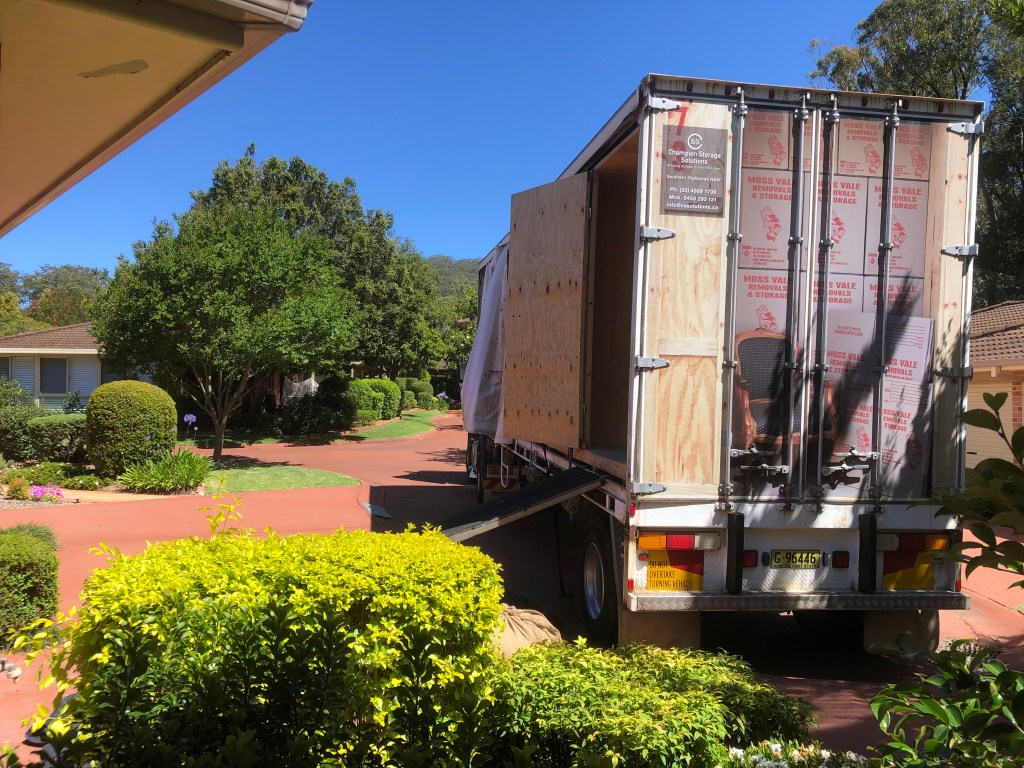
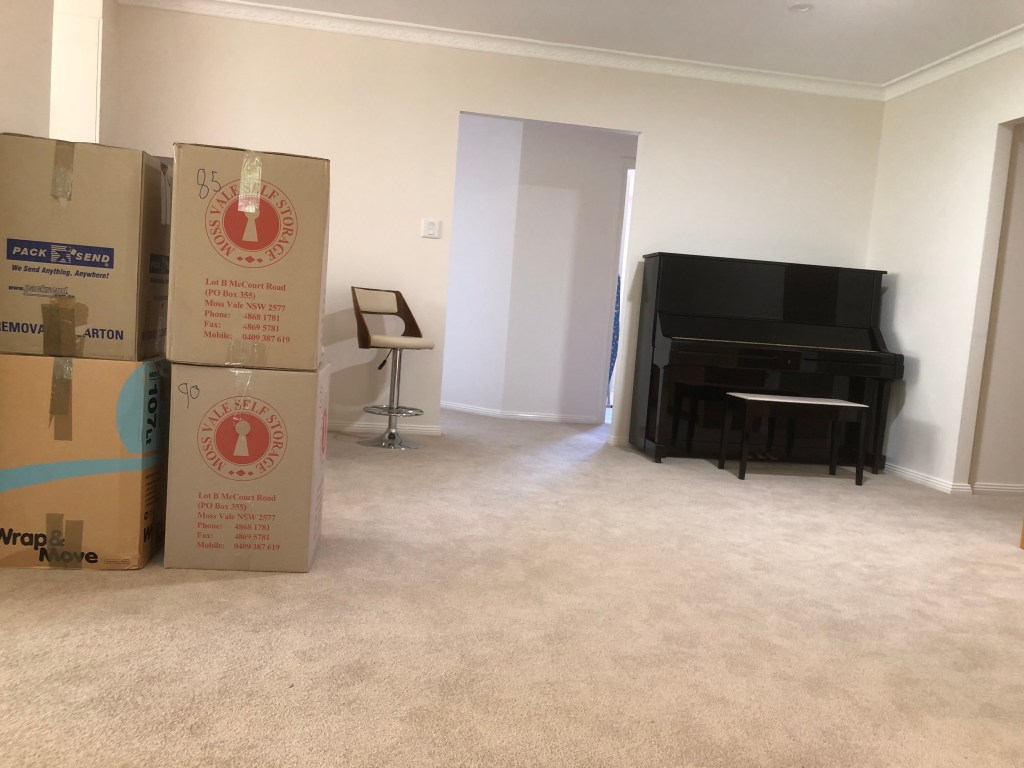
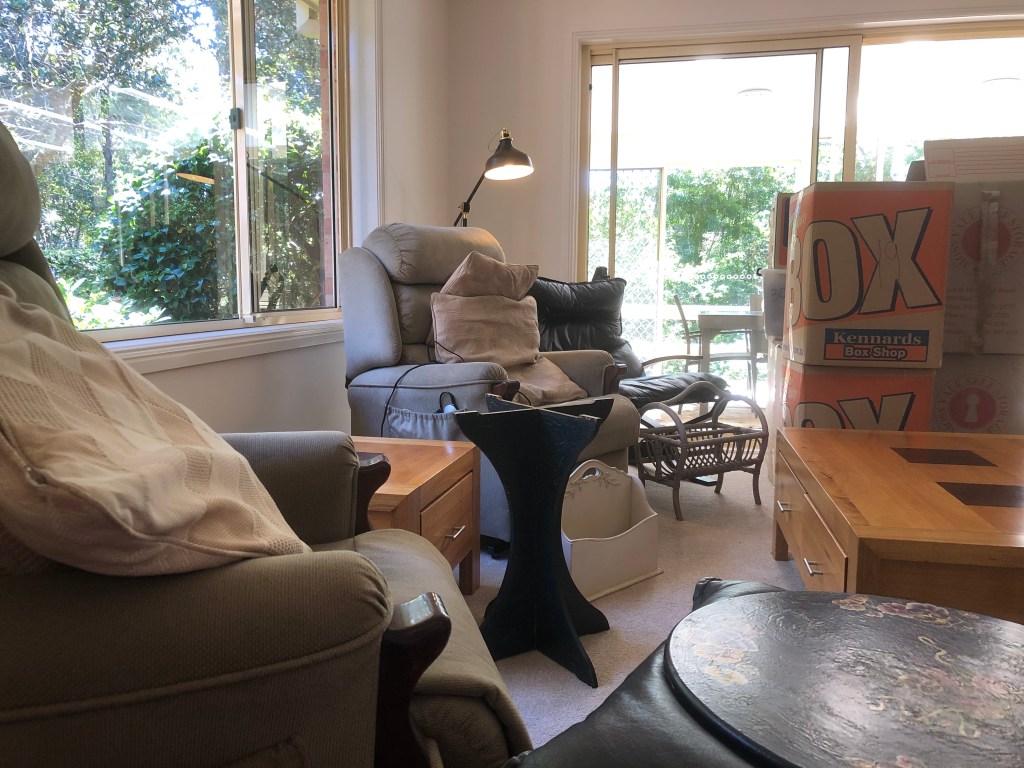
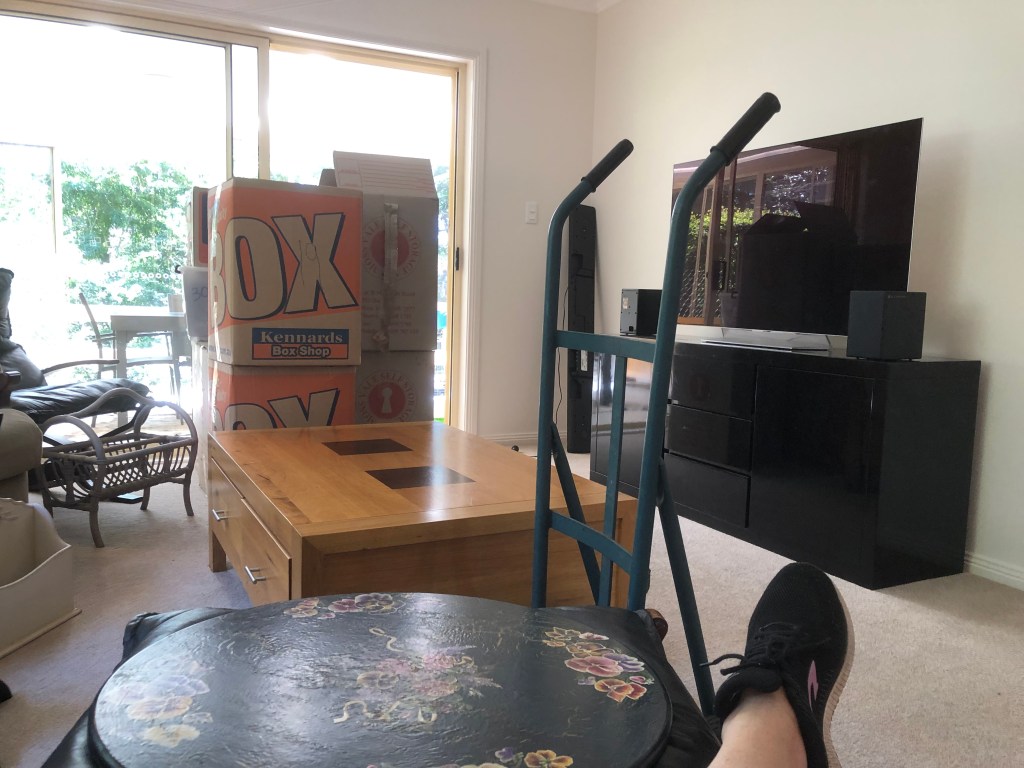
Today our furniture and countless number of boxes of ‘things’ were finally delivered to our new Villa in the very pretty Tarragal Glen Retirement VIllage at Erina in the Central Coast of NSW. It has been a HUGE day, and we are now relaxing, feeling totally exhausted in our caravan back up at the Canton Beach Holliday Park.
We have experienced such an overwhelming feeling of anticipation, excitement and just a little trepidation about our decision to finally “down size” and leave our beautiful Southern Highlands home on Bong Bong Hill in Moss Vale.
The boys were already unpacking the first van when I dropped Norm off at the Villa this morning. I then needed to deliver Rosie and Coomalie to their ‘Pet Restort’ up the road, where they will be chilling out in stye for the next three days.
By the time I arrived back at our new home, the Big Truck had arrived, and boxes and furniture was being transferred into every spare space possible by those two fit, strong young men. With the temperature rising up into the early 30’s, they worked steadily and cheerfully for the next 5 hours. We were both in awe of their ability to keep going. Finally by about 3pm the truck was empty and we bid them farewell and safe journey home.
We then sank into our lounge chairs feeling totally exhausted and overwhelmed. It was 4pm before we could finally drag our weary and starving selves back onto our feet and into the car to drive up to Erina Fair for a very very late lunch. Alhough most of the food outlets were closing or closed, we found the fabulous owner off AROMAS, Ramazan was willing to whip us up a couple the best sandwiches we have enjoyed for ages.
Feeling revived thanks to Ramazan, we returned to our Caravan home. It felt strange without our fur babies. We have become so used to living together, the four of us: Norm, Me, Rosie and Coomalie since moving from Bong Bong Hill and into the Belagio on 10 October.
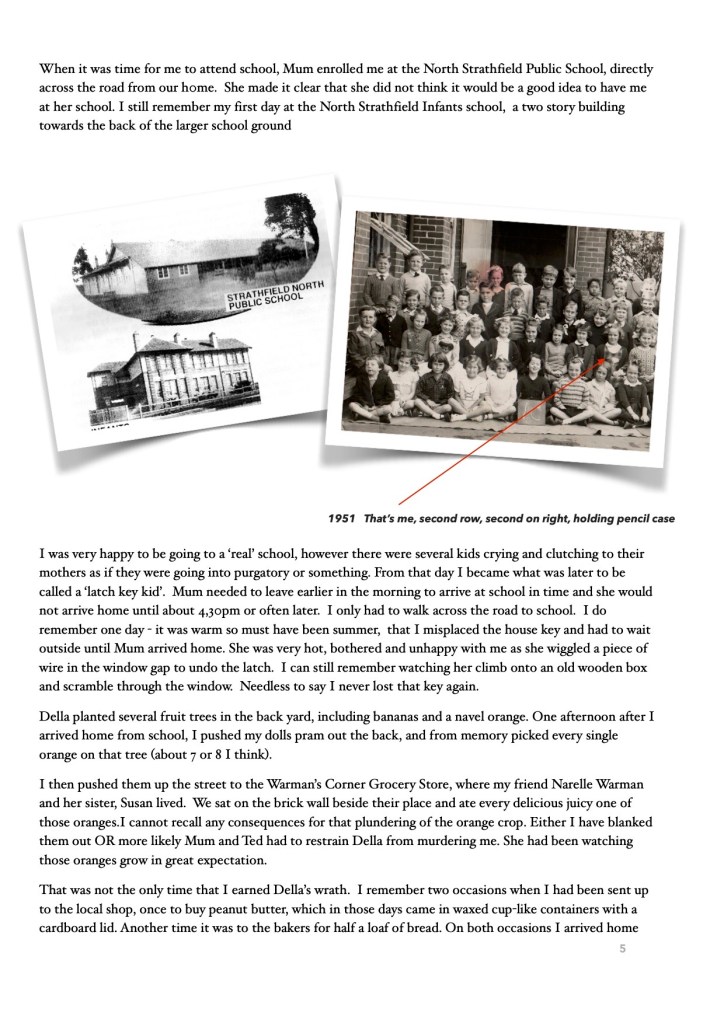
My Uncle Ted first introduced me to the magic of aeroplanes and flight back in 1951, when he took me to an air show at Bankstown airport. With the dim distance of time my memory of that day is very sketchy. I do recall the dust, smell, sounds and excitement of seeing the planes take off and fly overhead. Joy flights were on offer, however Uncle Ted’s kindness did not extend to that indulgence.
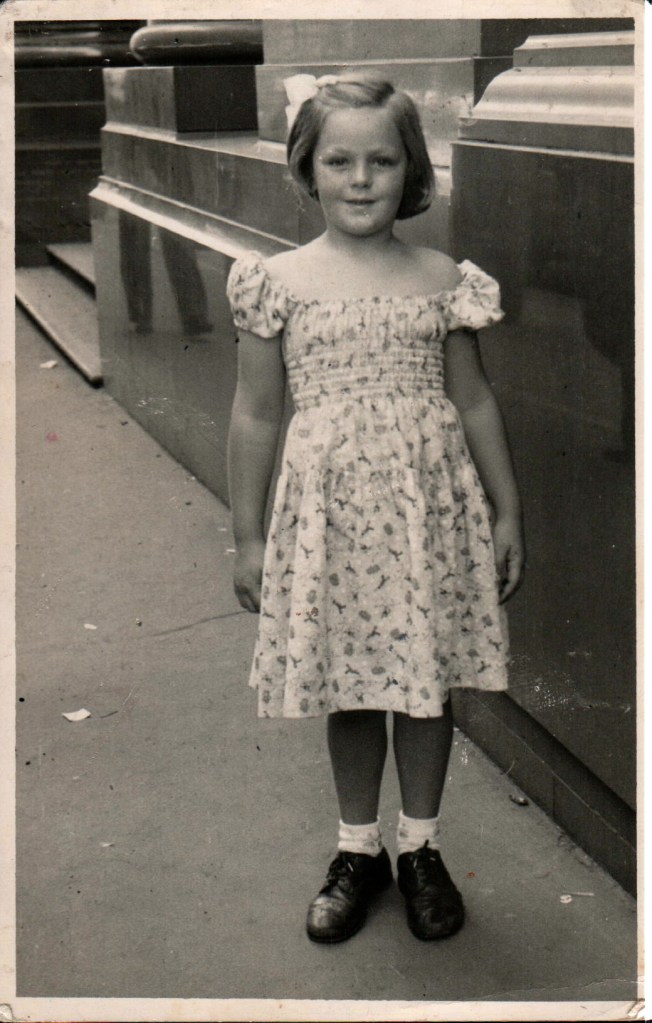
Susan, George St, Sydney about 1951
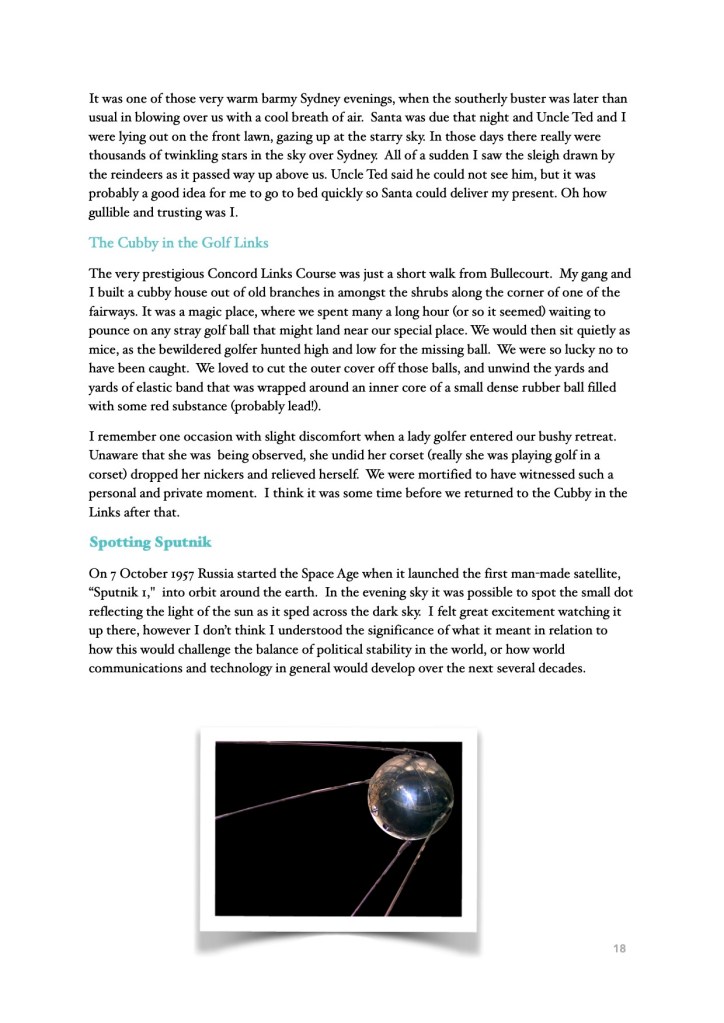
I remember lying out on the front lawn one night with Uncle Ted waiting to catch a glimpse of the first man made satellite , when it passed overhead. The Russians had launched ‘Sputnik 1’ on October 4 1957.
It was such an exciting time; the dawn of the space age.
Back then there seemed to be more stars visible in the skies over Sydney. Light pollution was not so intense as it is now. It was reported in the newspapers that the small craft would be visible overhead just after 7.35pm. We watched in awe as the light, like a small star moved across the sky. What we were seeing was the sun light reflected off the shiny surface of the man-made craft.
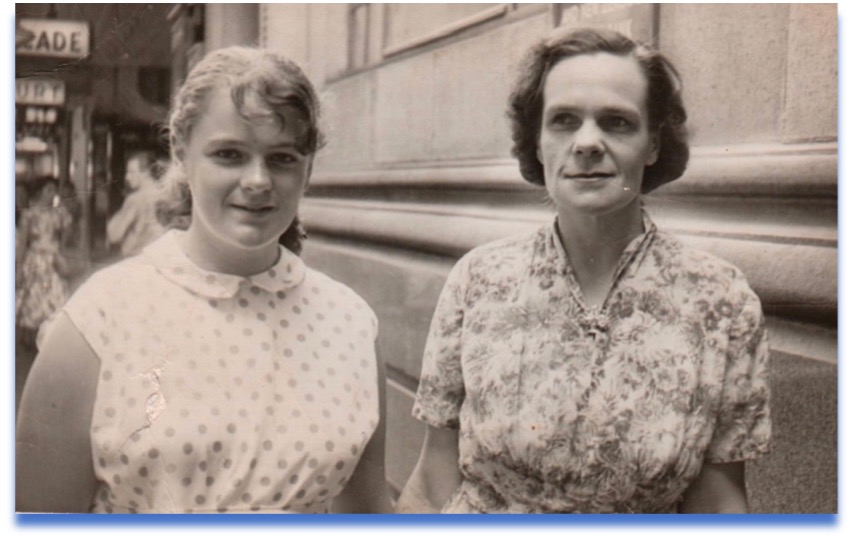
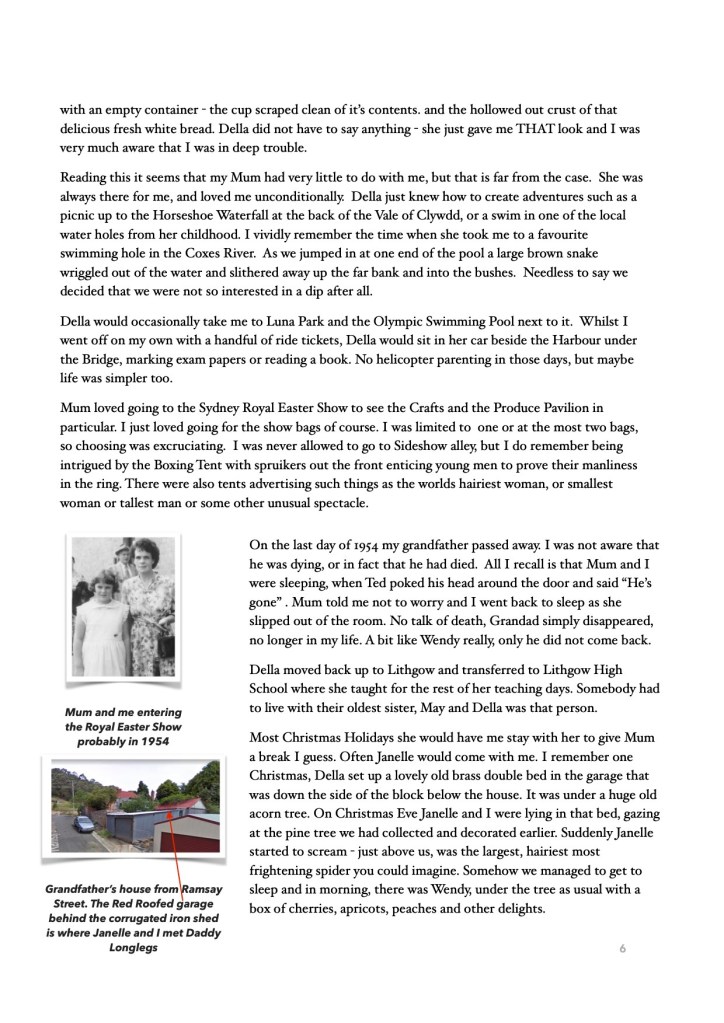
In my diary dated Friday, 21 August 1959, I wrote about spending the day with my Mum shopping in ‘Sydney Town’. I think this photo of us was taken that day as we walked along George Street, by one of the many Street Photographers of the day.
Susan and Mum, Edna, George Street, Sydney 21 August 1959
We could well have been walking back from the ‘Wynyard Newsreel’, where we “…saw some really funny comedies.” After which we “…went to the Federation and had a pie each in a conference room.” The ‘Federation’ was the Teachers’ Federation’, which at that time, was in the old Queen Victoria Buildings.
When we arrived home that afternoon, I recorded the following:
Page 69C 1969 Diary
Until then, the furthest distance I had travelled was by train or car between Sydney and Lithgow, where my Grandfather and Aunt May lived. Following Grandfather’s death in 1954, Aunt Della returned to Lithgow, where she taught at the Lithgow Highschool for the rest of her long teaching career.
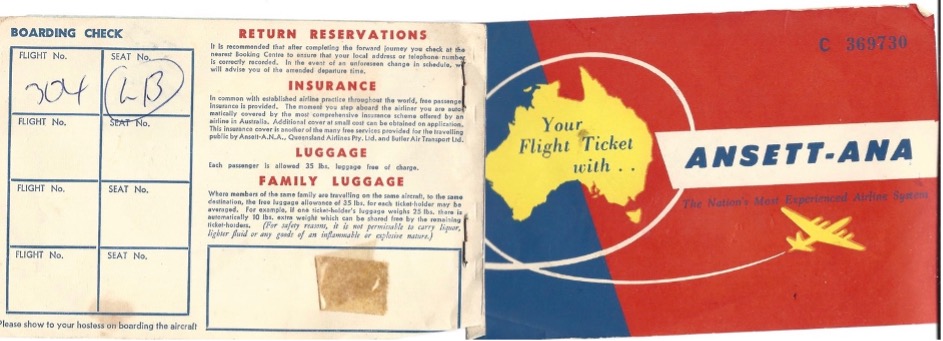
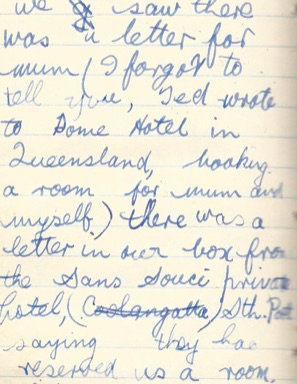
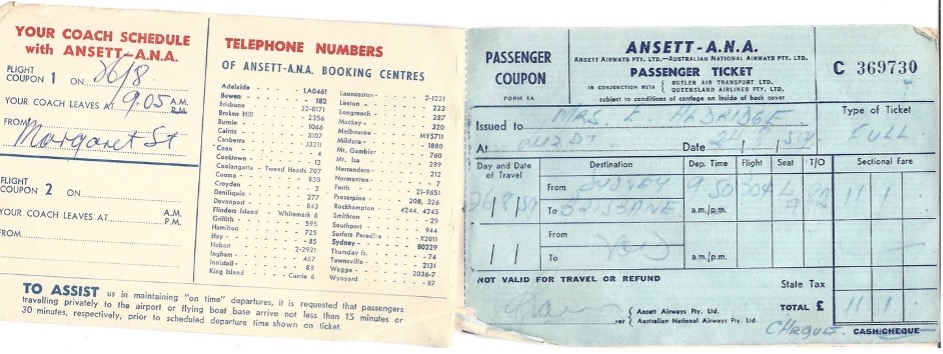
I was very excited at the prospect of this trip up to Queensland. When Uncle Ted popped over to our house the next day, he convinced my Mum to take the bold (for her) step of flying up to Queensland. I wonder how she felt about it. I was very excited of course. On 24 August, Uncle Ted confirmed that he had booked our seats for two days’ time, on a flight to Brisbane, where we would then transfer to a Coach to Southport. He had attempted to book us on a direct flight to Coolangatta, but they were fully booked.
Ticket, Flight 304 Sydney to Brisbane
Leading up to the big day, I wrote the following in my diary:
Tuesday 25 August 1958
“…Ted said he’d sleep here tonight so he can drive us to Mascot Airport tomorrow. (we’re going to Queensland)”
Wednesday 26 August 1959
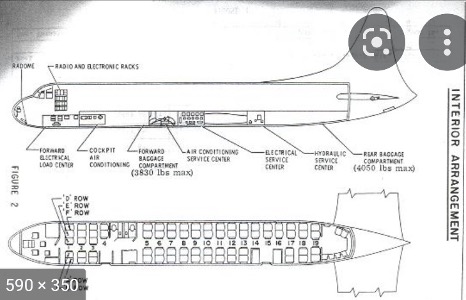
“Got up at 6 o’clock and got dressed. Had breakfast. Ted drove us into Mascot where we gave our luggage in at the lounge. We then sat around waiting for our plane. Ted took a photo of the plane. At 5 to 9 a voice over the loudspeaker said “Will passengers for flight 304 to Brisbane please assemble at the gate. We did, then went on board. Mum and I had a seat right in the tail. “
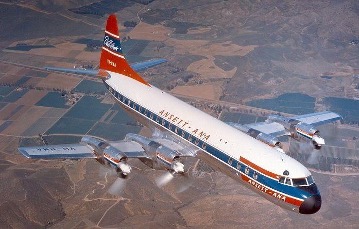
Ansett ANA Lockheed Prop Jet similar to ours
From the moment we took off from Mascot, I was mesmerised by the views out of the window. I was in awe of the experience of flying above the city and beyond.
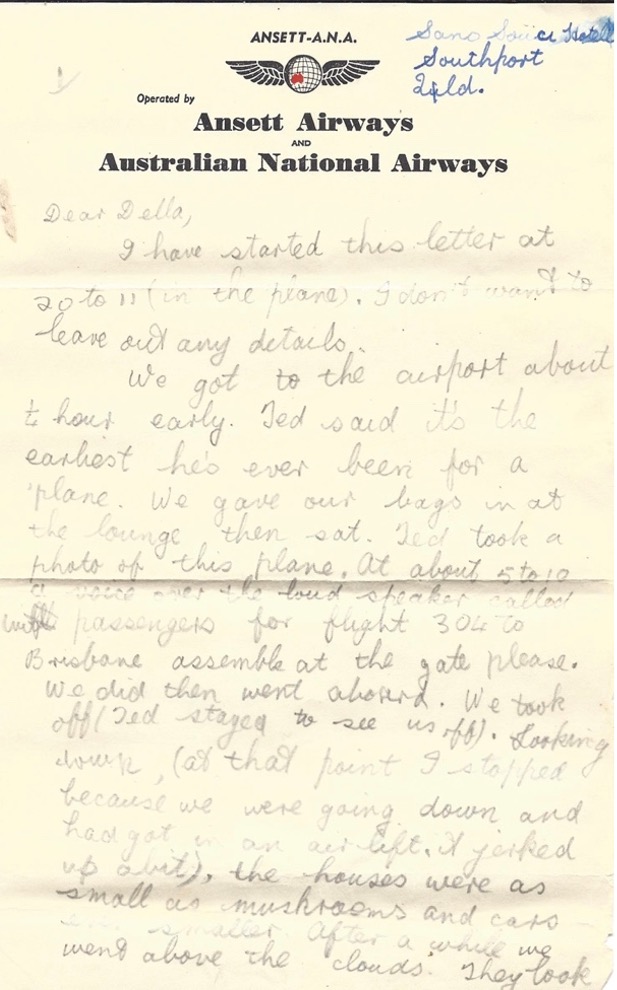
There was writing paper supplied on board, and so I started writing a letter to Aunt Della before I could forget the details.
Page 1 Letter from me to Aunt Della
I have made a transcript below:
I have made a transcript below:
Sans Souci Hotel
Southport
Qld
Dear Della,
I have started this letter at 20 to 11 on the plane. I don’t want to leave out any details.
We got to the airport about ¼ hour early. Ted said it’s the earliest he’s ever been for a plane. We gave our bags in at the lounge then sat. Ted took a photo of this plane. At about 5 to 10 a voice over the loudspeaker called passengers for flight 304 to Brisbane to assemble at the gate please. We did then went on board. We took off (Ted stayed to see us off). Looking down … (at that point I stopped because we were going down and had got into an air lift, it jerked us a bit). The houses were as small as mushrooms and the cars were smaller. After a while we went above the clouds. They look like masses of cotton wool.
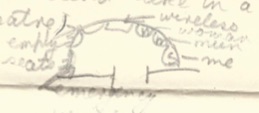
Later the air hostesses (3 of them) came and handed the passengers creamed coffee and biscuits. Mum had struck up a talking friendship with the woman next to her (we were in the tail and the seats went round like a curved picture theatre.
We went inland at places and when the clouds broke we saw snow on some of the mountains. The rivers looked like threads of wool.
I was surprised to find out that when we landed, we were at Brisbane because it only seemed like 5 minutes since we left Mascot and the area was just like a sun burnt bush.
When we got to our Ansett ANA bus to take us into Brisbane, we got on it and the driver drove off. The houses are very queer. They are built very high up on wooden posts and lattice work is put there to cover the space between the house and the ground.
When we got to the terminal we found out the red and blue bus to Southport wasn’t due to leave until 3 o’clock. It was only 12 o’clock. So while waiting for our bags to arrive we walked around Brisbane. The shops are more spacious than Sydney.
After that we sat down on a seat overlooking the Brisbane River and ate our lunch (the sandwiches)
We went back to the terminal and got our bags. We then caught a taxi to the Greyhound bus terminal. While waiting for our bus we had a cup of coffee then read the Woman’s Weekly that we got at Mascot. The Telegraph is only 4d.
The bus arrived and we were off again. The scenery is beautiful. When we arrived we got our room then went down to the dining room for tea (6pm to 7pm). We had lamb and vegetables and jelly and cream and coffee (yum).
This morning we went for a walk along the beach before breakfast. We got home in time for it (8am to 9am). We had sliced apricots and Wheaties and poached egg and potato and coffee. Now we are off to the beach again.
See you,
Yours truly,
Della was always very interested to hear what we had had to eat!
That first flight was the beginning for me of a life-long love of flying.
Southport
Qld
Dear Della,
I have started this letter at 20 to 11 on the plane. I don’t want to leave out any details.
We got to the airport about ¼ hour early. Ted said it’s the earliest he’s ever n for a plane. We gave our bags in at the lounge then sat. Ted took a photo of this plane. At about 5 to 10 a voice over the loudspeaker called passengers for flight 304 to Brisbane to assemble at the gate please. We did then went on board. We took off (Ted stayed to see us off). Looking down … (at that point I stopped because we were going down and had got into an air lift, it jerked us a bit). The houses were as small as mushrooms and the cars were smaller. After a while we went above the clouds. They look like masses of cotton wool.
Later the air hostesses (3 of them) came and handed the passengers creamed coffee and biscuits. Mum had struck up a talking friendship with the woman next to her (we were in the tail and the seats went round like a curved picture theatre.
We went inland at places and when the clouds broke we saw snow on some of the mountains. The rivers looked like threads of wool.
I was surprised to find out that when we landed, we were at Brisbane because it only seemed like 5 minutes since we left Mascot and the area was just like a sun burnt bush.
When we got to our Ansett ANA bus to take us into Brisbane, we got on it and the driver drove off. The houses are very queer. They are built very high up on wooden posts and lattice work is put there to cover the space between the house and the ground.
When we got to the terminal we found out the red and blue bus to Southport wasn’t due to leave until 3 o’clock. It was only 12 o’clock. So while waiting for our bags to arrive we walked around Brisbane. The shops are more spacious than Sydney.
After that we sat down on a seat overlooking the Brisbane River and ate our lunch (the sandwiches)
We went back to the terminal and got our bags. We then caught a taxi to the Greyhound bus terminal. While waiting for our bus we had a cup of coffee then read the Woman’s Weekly that we got at Mascot. The Telegraph is only 4d.
The bus arrived and we were off again. The scenery is beautiful. When we arrived we got our room then went down to the dining room for tea (6pm to 7pm). We had lamb and vegetables and jelly and cream and coffee (yum).
This morning we went for a walk along the beach before breakfast. We got home in time for it (8am to 9am). We had sliced apricots and Wheaties and poached egg and potato and coffee. Now we are off to the beach again.
See you,
Yours truly,
Della was always very interested to hear what we had had to eat!
That first flight was the beginning for me of a life-long love of flying.
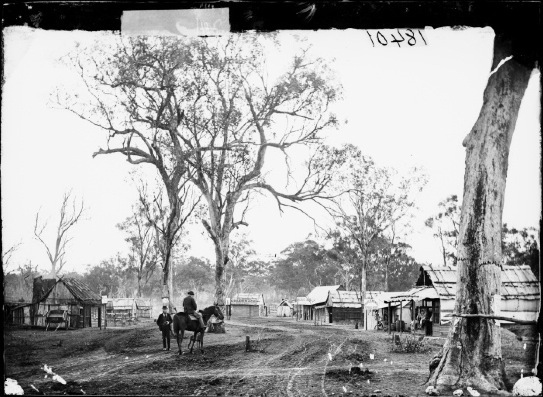
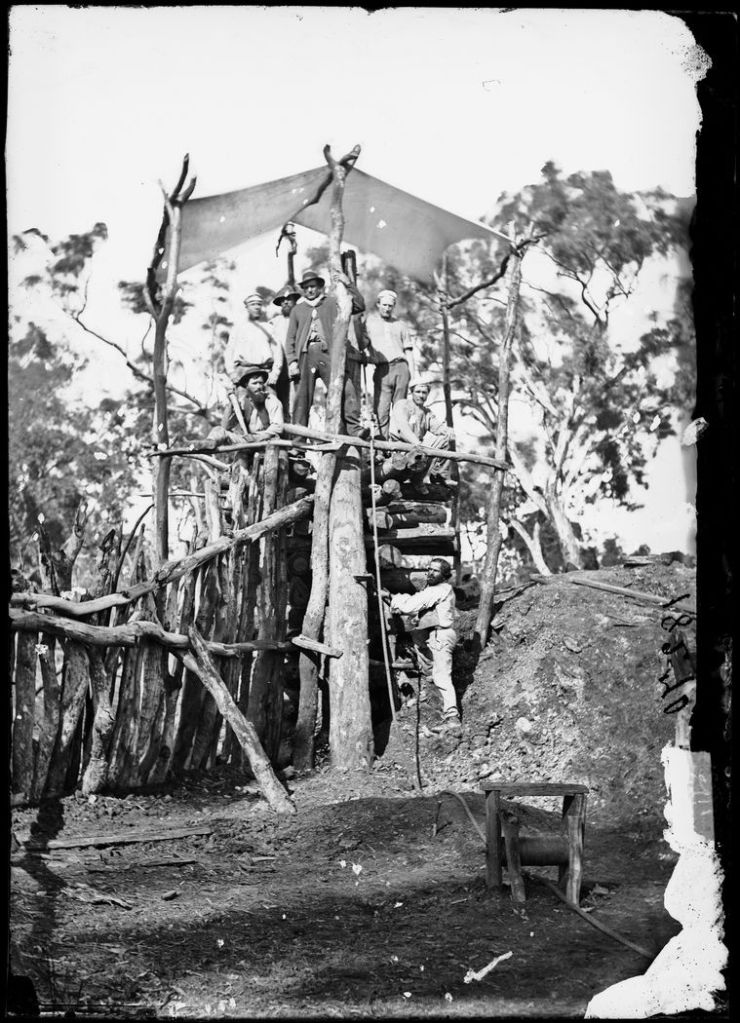
Whilst researching my Aldridge family history, I came across a framed copy of a page from the old ‘New Gulgong Advertiser’ on the wall of book shop in the town of Gulgong – the shop is no longer there, and I have not been able to find the article again. This is a copy of the notes I took that day.
“In the 60’s I lived with my father on Bobadeen where there in ’67 or ’68 came Ben Hall. Hall was the first man to pass through the gap to Bobadeen Hills which is called Ben Hall’s Gap.
Gardiner also came to Bobadeen where the two bushrangers met and spent some days together but eventually quarrelled and each went his separate way. Gardiner making for Peak Downs where he became interested in a store and settled down to a peaceful and honorable life but was eventually arrested. Whilst at Bobadeen the two bushrangers did some excellent practice shooting and for many years the sapling with target attached remained to be seen and as far as I know might still be there.
Gardiner showed father a nugget of gold which he said he had picked up in the vicinity of Red Hill (now Gulgong). Father went to Cooyal where he told three fencers of Gardiner’s find. They went in search of the place and found the Old Gulgong Reef but got nothing of any account there from.
Some time later Tom Saunders came from Two Mile Flat and whilst passing through found a nugget in the vicinity of where Railway Dam is or on Red Hill (Gulgong). On returning to Two Mile Flat he told diggers there of his find and a mild rush was on.
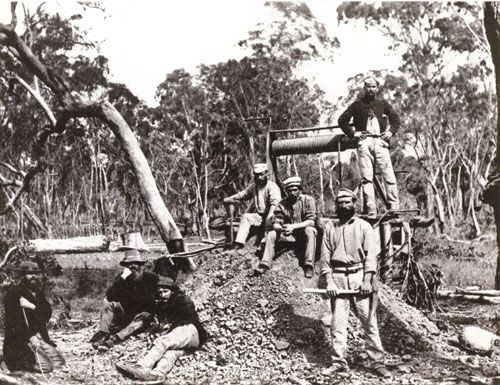
After getting as they thought the best of the gold most of them joined in a rush to Tullawang. Father and I then came along in 1870, and went to Adam’s Lead near where the Gulgong Saleyards now stand. Adams had sunk several shafts, each round about 18 feet. The rush caused by Saunders’s find bought about three or four thousand people to Gulgong but a great many had left for other fields when we came on to the scene. My father and I went into one of Adam’s deserted shafts going through a false bottom and at 25 feet bottomed on Slippery Jack. We then tried a 2nd shaft with the same result. We went into the third shaft and were then joined by Cragan, Bradley and Cook. They took the first shift whilst father and I, who was then a boy of 13 or 14 years, went on the 2nd shift. I had to work down the shaft as I was not strong enough to wind father up and down. I was at work at night when a drunken man came along and looking down saw that I had got through the false bottom and onto quartz. He spread the news and before morning there were three hundred men on the spot.
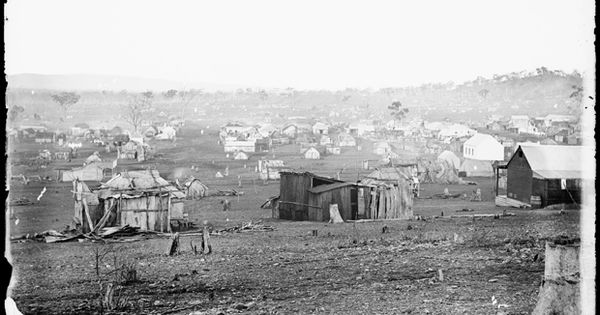
Main St Gulgong
Mine Head & miners Gulgong
Small Claim 1872
Gulgong Gold Field from Church Hill 1872
Peter Wolvendale measured our claim off and took from us an area which exceeded our measurement and on account of my being a minor tried to take my share. Over this there was court work and Mr Bellanclanty being a very just and straight man ruled that as I was the actual finder of the gold I was entitled to my share. I might better have lost my share then as it would have saved much bother afterwards.
My father got possession of my share and would not hand it over to me but eventually he bought for me from Mr Thomas Isbester a 40 acre Crown Grant being portion 10 Parish Guntawang, County Phillip. The land was transferred from Thomas Isbester to myself, William Aldridge, Isbester’s name being erased from the maps etc and my name substituted and my name William Aldridge is still in evidence on the maps etc. This is as it should be as I did not at any time dispose of any land or sign my name to any transfer nor did I authorise anyone to deal in the land on my behalf.
If the land is not mine, why is my name allowed to remain on the maps etc as the owner? In that case the Lands Department must be using my name illegally.
In 1878 my father requested me to sign transfers enabling him to sell the land and this I refused to do. I could not write at the time as I had received no schooling. When I persisted in my refusal he set a trap for me. Being disgusted with the treatment that I had received at my father’s hand and quite determined not to sign away my land I decided to go to Queensland and on the eve of my departure he (father) stole a pony from Mrs McDonald of “The Lagoons” and sent it by another man to me as a parting gift. Some distance on my way I was overtaken by the police who, finding the stolen pony in my possession brought me back to Gulgong then to Mudgee where I had to stand trial. I had no receipt for the pony and being an uneducated lad of about 19 years and knowing nothing of Law and how to go about defending myself was sentenced to 18 months in Mudgee Gaol.
Whilst in Gaol Clark, the solicitor and Dick the gaoler came to me and tried to get me to sign the papers and on my refusal to sign put me in the cells for three days. They then gave me another two days in the cells on my further refusal to sign and only desisted the persecution when a man being released threatened to report them.
The swindle to obtain possession of this land from me was perhaps the greatest bit of roguery since the famous Tichburne case. I, a lad in my teens and uneducated, being by a trick put in gaol to enable conspirators and swindlers and forgers to carry out their plans and this they did for the time successfully but the land is till my property and all the roguery in the world will not alter that fact and whilst I have life I intend to fight for my rights and I will so arrange that when my life has ended there will be others to carry on the fight, and no one will ever get a true title to the land without my consent or that of my heirs. There have been several transfers from me to Edward Aldridge, having been a swindle and a forgery, all subsequent transfers must be valueless. Being a poor man I have not been able to fight this swindle in the manner I would like, but I am looking to government departments concerned to probe into the matter and to see that I get justice so long delayed. I am now in my 79th year and am badly broken up from rough life in Queensland and find it very hard deprived of possession of my property where I hoped and still hope to spend the remaining years of my life freed from the necessity of depending on an old age pension which is loathsome to me. Should I not have been robbed of my land I should never had to draw old age pension
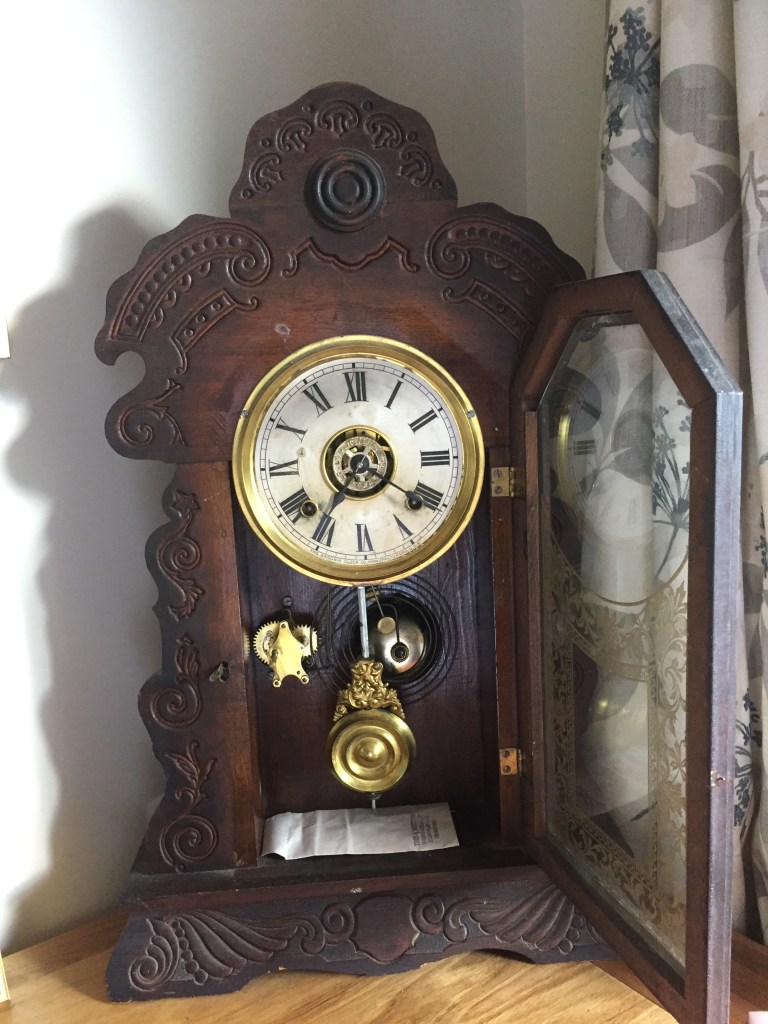
Gertie and her baby daughter, were home alone in their cottage in the Vale of Clywdd. Arthur was away working at the colliery down the Gap Road. It was a welcome diversion from the young mother’s daily routine when the old Indian hawker Ali Khan called by in his horse drawn waggon. She was hoping to buy a new clock.
“I have recently received a shipment from the Ansonia Company in America of some very handsome chiming mantle clocks. They have very efficient brass movements,” advised the man.
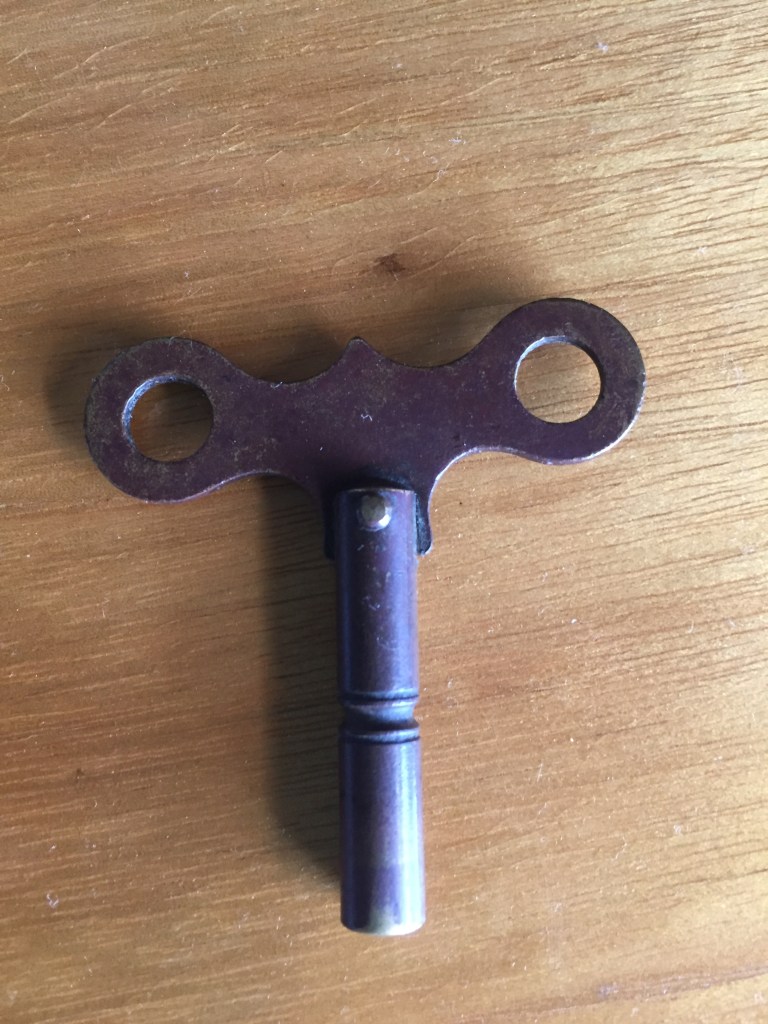
Gertie chose a manogany coloured clock with an attractive pattern carved into the case. The pendulum was a gleaming golden colour and the spring mechanisn was calibrated to maintain the time for 28 days without rewinding with the huge old brass key.
For the next forty years the clock sat on the mantlepiece over the fire in the lounge room. Arthur never missed rewinding it on the last Sunday of every month. In later years, the 6 pm chimes of the clock would signal it was time for the family to be quiet as Arthur turned on the radiogram to listen to the ABC news.
Many years after my Grandfather’s death, my Aunt kindly passed the clock on to me. At some point in time the spring had broken and it now needs to be rewound once a week. The sound of its chimes bring back many happy childhood memories of times spent visiting my Grandfather. It now has pride of place on a cabinet in my home.




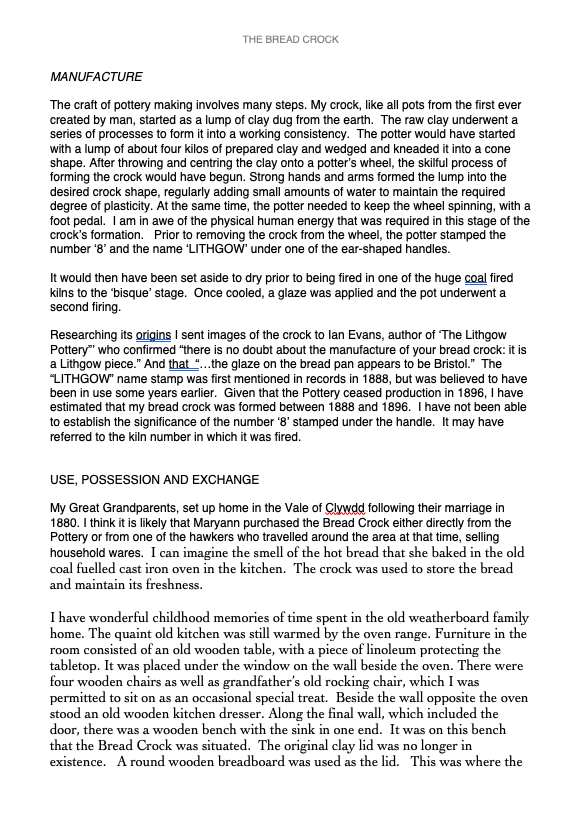
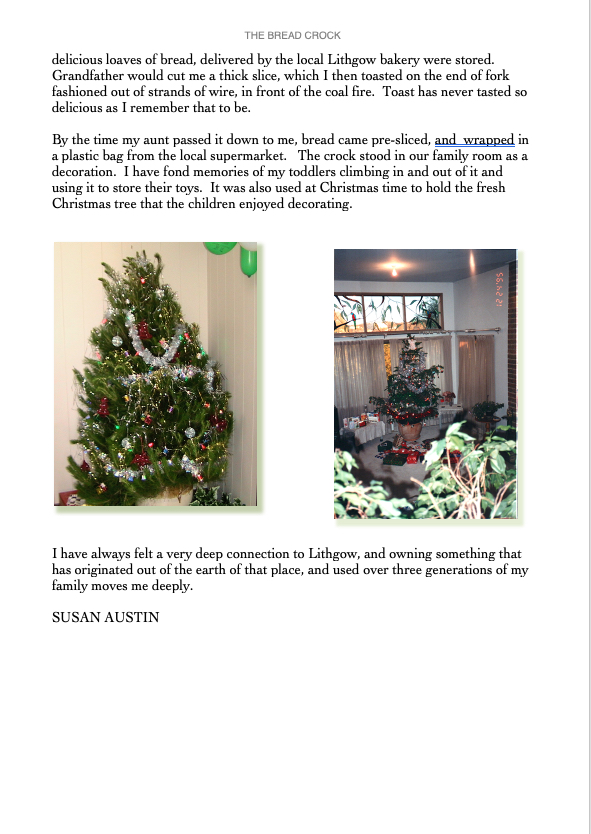
 Sue's Scribbles